What If Every Voter Had Their Own EVM?
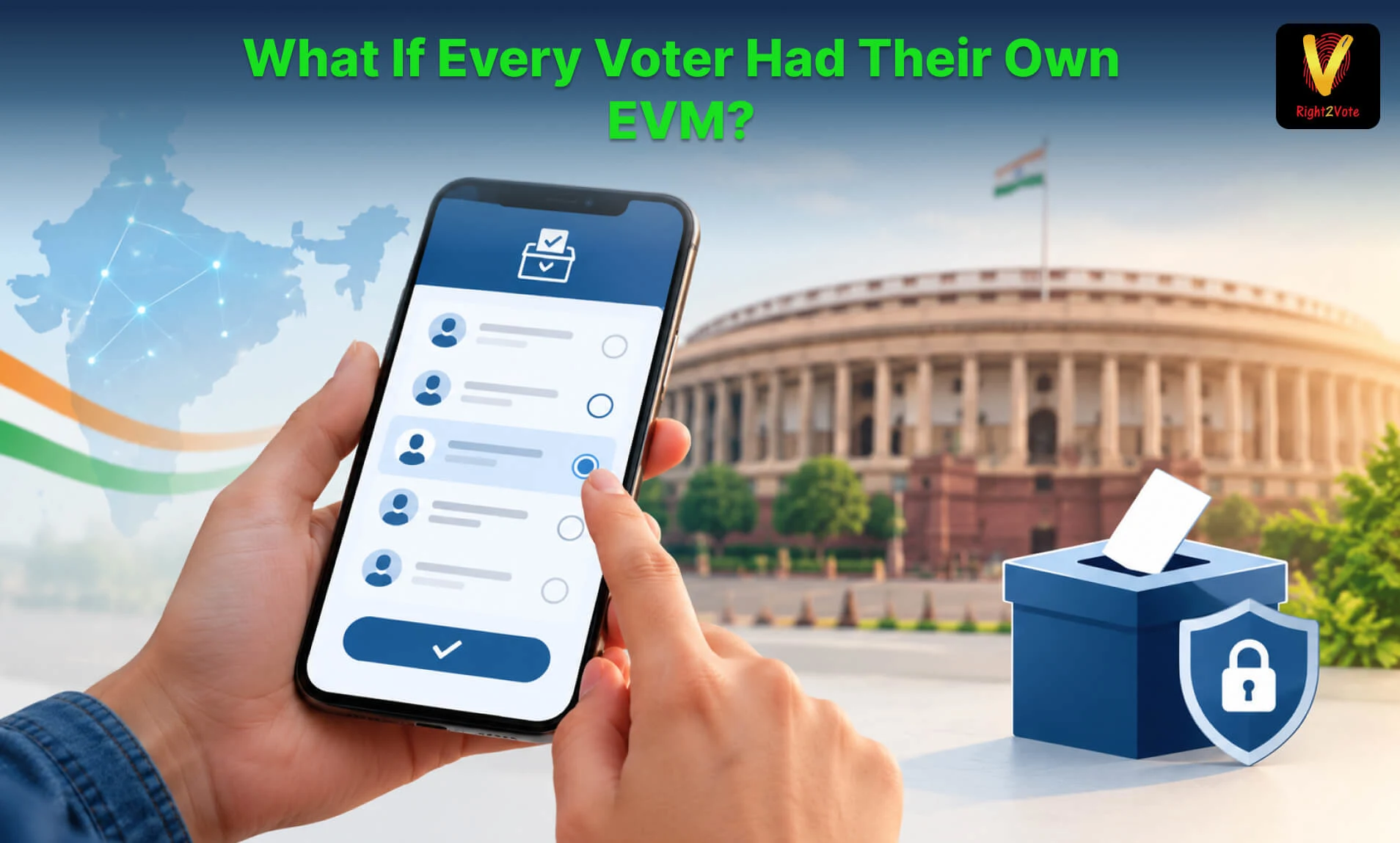
Imagine a country where every eligible voter has access to a personal digital voting system. There are no long queues outside polling booths, no need to travel long distances to cast a vote and no dependence on thousands of physical Electronic Voting Machines (EVMs). A voter can participate in an election securely using a digital device, while the election authority ensures that every eligible vote is recorded, protected and counted correctly.
Sounds like the future of democracy? India has already demonstrated its ability to build digital solutions that serve millions of people. The Unified Payments Interface (UPI) has transformed how Indians transfer money, pay bills and conduct everyday transactions. India is also developing digital solutions for identity, public services and business.
So, an important question deserves serious discussion: If India can transform payments through digital technology, why can’t we explore digital voting as another step towards a more accessible democracy?
With growing discussions about election transparency, voter convenience and the future of Electronic Voting Machines, online voting deserves attention as a possible part of India’s electoral future.
EVM Controversies and the Question of Public Trust
Electronic Voting Machines have changed how India conducts elections. Compared with traditional paper ballots, EVMs help speed up vote counting and reduce the need to handle large quantities of ballot papers.
However, elections are not only about counting votes. They are also about ensuring that citizens have confidence in the entire process.
Whenever questions arise about election procedures, machine security or the possibility of manipulation, public discussion becomes intense. For example, allegations and videos circulating around elections in West Bengal and other states can raise questions among voters about whether the electoral process is transparent. Such allegations must be investigated through evidence and established procedures rather than treated as proof of wrongdoing.
The Election Commission of India maintains that EVMs have technical and administrative safeguards. These include testing, mock polls, stakeholder participation and the Voter Verifiable Paper Audit Trail (VVPAT), which allows voters to check a printed slip showing their selected candidate.
Nevertheless, the larger question remains relevant: how can India continue to strengthen public confidence in elections as technology evolves?
The answer should not be to accept every allegation as true or to dismiss every concern without discussion. The answer should be to encourage transparency, independent verification and continuous improvement in electoral technology.
What If We Could Move Beyond Physical EVM Machines?
Imagine an election in which every eligible voter receives a secure digital voting invitation. Instead of travelling to a polling station and pressing a button on a physical EVM, the voter accesses an authorised digital voting system using a mobile phone or computer.
The voter verifies their identity through the prescribed authentication process, views the available candidates and selects their preferred candidate. The system records the vote while maintaining ballot secrecy, and the election authority can verify the overall process through independent checks and audits.
This is the basic idea behind remote electronic voting.
The goal is not simply to replace a machine with a mobile application. It is to rethink how voters participate, how election authorities manage the process and how the public can verify that the results are trustworthy.
A well-designed digital voting system would need to prevent duplicate voting, protect voter identities, maintain ballot secrecy, resist cyberattacks and provide reliable evidence that votes have been recorded and counted correctly. It would also need safeguards against coercion, vote buying, impersonation and unauthorised access.
These challenges are serious. Digital voting is not automatically more secure simply because it uses modern technology. However, they are important reasons to research, test and independently evaluate new voting methods rather than reject the possibility of innovation altogether.
India Has Already Shown the World What Digital Technology Can Do
UPI is one of India’s most recognised digital success stories. It has made digital payments accessible to ordinary citizens, small businesses, merchants and large organisations. People can transfer money within seconds without exchanging cash or visiting a bank branch for every transaction.
The lesson from UPI is not that payments and elections are identical. They are not. A financial transaction and a democratic vote have different security, privacy and legal requirements.
The larger lesson is that India can develop technology around the needs of its population and make digital services accessible at scale.
India has the technical talent, software industry, cybersecurity expertise and digital infrastructure to explore new approaches to voting. Indian-developed digital voting platforms already demonstrate how organisations can conduct elections and collect votes remotely.
Could India eventually develop a trusted digital voting framework for public elections, just as it developed its own digital payment ecosystem?
It is a question worth exploring through controlled pilots, public consultation, independent security assessments and appropriate legal reforms.
Why Can Housing Societies and Associations Use Online Voting While National Elections Still Face Different Challenges?
Here is an interesting contrast.
Housing societies, Resident Welfare Associations (RWAs), professional associations, educational institutions, clubs and other organisations regularly need to elect representatives or make collective decisions. Their members may live in different cities, travel frequently or find it difficult to attend a physical meeting.
Online voting can help these organisations reach more members and simplify their election processes.
For example, a housing society may need to elect its managing committee. A professional association may need to elect its office bearers. A college may want its students to select their representatives. An organisation may need members to approve important resolutions.
A digital voting platform can allow eligible participants to vote using a phone or computer, subject to the election’s rules and the platform’s security configuration.
However, national and state elections operate under a different legal and administrative framework. They involve millions of voters, constitutional requirements, political competition, varying levels of digital access and the need to protect citizens from coercion and cyber threats on a much larger scale.
The use of online voting by private or member-based organisations does not automatically authorise its use in public elections.
Still, the experience of conducting digital elections in smaller settings can contribute to discussions about usability, accessibility, authentication, secrecy and election management. The important question is how these lessons can be independently tested and adapted to meet the much higher requirements of public elections.
What Is the Government Waiting For? Is It Time to Explore Digital Voting?
India has made major investments in digital infrastructure. Citizens increasingly use online services for banking, shopping, communication, education and public administration.
Naturally, people may ask why voting has not followed the same path.
There is no single reason that explains the entire issue. National elections require constitutional and legal authority, extensive security testing, consensus among stakeholders, safeguards for voters without reliable internet access and confidence that results can be independently verified.
A digital election system must also protect voters who may be asked to vote under pressure from employers, family members, political groups or other individuals. A physical polling booth offers a controlled environment for private voting, while remote voting introduces additional challenges in protecting a voter’s freedom to make an independent choice.
These concerns deserve serious attention. But they should encourage research and transparent evaluation rather than end the discussion.
The government, election authorities, technology experts, cybersecurity researchers, political parties and civil society can work together to examine whether digital voting could safely serve particular election categories in the future.
India does not need to abandon its existing election system overnight. It can study new technologies, establish clear standards, conduct carefully designed trials where legally permitted and publish independent findings.
The objective should be simple: make voting more accessible without compromising the secrecy, security, fairness or credibility of elections.
Right2Vote: Bringing Digital Voting to Real-World Elections
Digital voting is not merely an idea for the future. It is already being used by organisations that need a convenient way to conduct elections and collect decisions from their members. Right2Vote has conducted more than 22000 elections in the last 11 years. It has led to not only huge savings in cost and time but also a substantial increase in voter participation.
Right2Vote is an Indian online voting platform that enables eligible voters to participate in elections through mobile phones and computers. It supports voting requirements for housing societies, RWAs, professional associations, companies, educational institutions and other organisations.
Instead of requiring every participant to be physically present at one location, Right2Vote can enable authorised voters to access an election remotely. Depending on the election’s configuration, the platform offers features such as voter authentication, secret ballot options, audit trails, voter receipts, selfie verification and other security controls.
For a housing society with hundreds of members, this can simplify the process of electing committee representatives. For an association with members spread across different cities or countries, it can make participation more convenient. For an educational institution, it can provide a digital method for conducting student elections.
Right2Vote’s approach reflects a practical principle: technology should make participation easier while respecting the rules and requirements of each election.
Its experience in organisational eVoting also contributes to the broader conversation about how digital voting can be designed, implemented and evaluated. However, using an online voting platform for an organisational election is not the same as being authorised to conduct India’s general elections. Any public-election application would require the relevant legal approvals, rigorous independent security evaluation and compliance with electoral requirements.
The message is not that every election challenge has already been solved. It is that India has the opportunity to build on existing digital voting experience and continue improving how people participate in collective decisions.
Could Digital Voting Make Democracy More Accessible?
One of the strongest arguments for exploring digital voting is convenience.
A person living away from their registered community may struggle to participate in a local association election. A working professional may find it difficult to attend a meeting during office hours. An elderly member or a person with a disability may face barriers when travelling to a physical voting location.
Remote digital voting can help reduce some of these barriers when the system is appropriately designed, and the election rules permit it.
It can also reduce certain administrative tasks associated with physical voting, including distributing paper ballots, arranging voting locations and manually processing votes. Digital systems may provide faster result processing and structured election records, depending on their design.
But technology alone cannot guarantee higher voter turnout, fairness or stronger democracy. Voters still need accurate information, freedom from pressure, accessible interfaces and confidence in the process.
A responsible digital voting model must also preserve alternatives for people who lack smartphones, reliable internet access, digital literacy or the ability to use online services independently. Accessibility should be part of the design, not an afterthought.
The goal should be to give more people a genuine opportunity to participate, not to exclude those who cannot easily go digital.
The Future of Voting Should Be Built on Trust, Not Fear
The debate about India’s electoral future should not be reduced to a choice between physical EVMs and digital voting. The real challenge is to determine which systems can best protect the democratic rights of every citizen.
Physical EVMs have established procedures and safeguards. Digital voting offers possibilities for remote participation and greater convenience, but it also introduces cybersecurity and voter-coercion risks that must be addressed in both systems.
Neither technology should receive unquestioning acceptance. Both should be evaluated against clear standards of security, secrecy, transparency, accessibility and verifiability.
If India wants to explore digital voting for public elections, the process should be open to independent scrutiny, involve diverse stakeholders and be supported by evidence rather than political claims or marketing promises.
Right2Vote demonstrates that online voting can already serve practical needs in organisational elections. The next step for India’s broader electoral conversation is to determine where digital voting may be appropriate, what safeguards are necessary and how public trust can be earned.
Conclusion
India’s digital journey has shown that technology can change how people access essential services. UPI transformed payments, and digital platforms have simplified many everyday activities.
Voting deserves the same spirit of innovation, accompanied by even greater care because democracy depends on every vote being protected and counted correctly.
Imagine a future where eligible voters have more convenient ways to participate, election authorities have reliable tools to manage the process, and every system is independently tested before it is trusted. That future will require research, cooperation, public debate and strong legal safeguards.
Right2Vote is already helping organisations bring elections online. Its experience represents one part of India’s wider digital voting journey, while the question of remote voting in national elections remains a matter for electoral authorities, lawmakers and the public to examine.
The question is no longer simply whether technology can be used for voting. Digital voting already exists in organisational settings.
The bigger question is this: Can India build a digital voting system that is accessible, secure, independently verifiable, legally sound and trusted by citizens across the country?
That is a conversation worth having and a future worth exploring responsibly.
To know more about Right2Vote’s election technology, please refer:
- Government of India certificates
- Features for eVoting
- Security and safety
- Pricing
- Our customers
- Contact Us
 Change The Election Method, Not The Officer
 NOTA Never Wins: What Is NOTA in Indian Elections?
 How to Conduct an AGM Online: A Complete Guide to Online Meetings and Voting