NOTA Never Wins: What Is NOTA in Indian Elections?
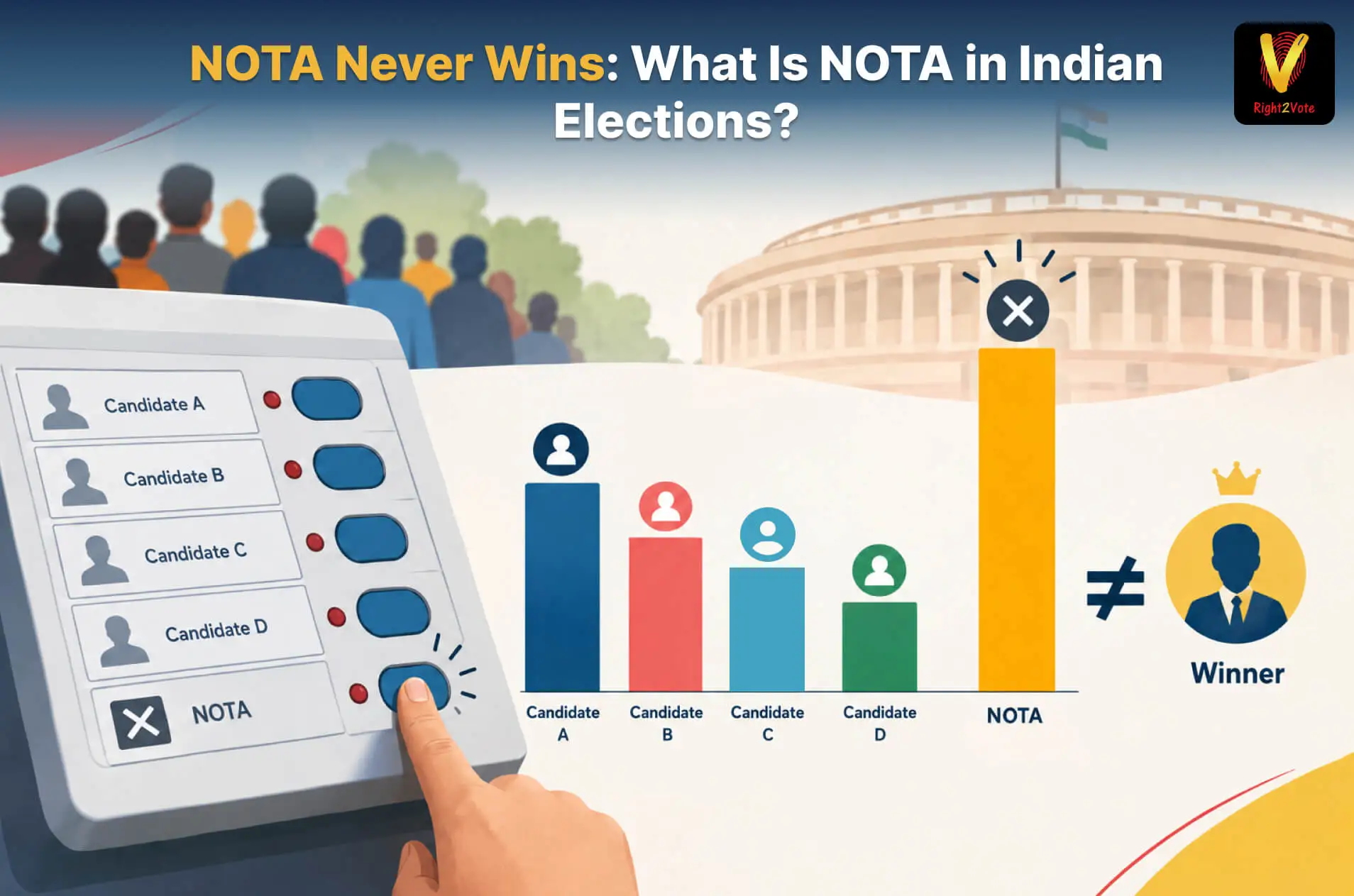
Elections are about choosing a representative, but what happens when a voter does not like any of the candidates? In India, voters have an option called NOTA, which allows them to express that they do not want to vote for any of the candidates contesting the election.
But there is an important fact that many voters do not know: NOTA can receive more votes than every individual candidate, but NOTA does not win the election. The candidate who receives the highest number of votes among the contesting candidates is still declared the winner.
So, what exactly is NOTA? When was it introduced in India? Which state used it first? And what happens if NOTA receives the highest number of votes? Let’s understand.
What Is NOTA?
NOTA stands for “None of the Above.”
It is an option provided to voters who do not want to vote for any of the candidates contesting an election. Instead of choosing a particular candidate, a voter can select the NOTA option on the Electronic Voting Machine (EVM).
The purpose of NOTA is to allow voters to express their dissatisfaction with all the candidates while still maintaining the secrecy of their vote.
For example, imagine that four candidates are contesting an election:
- Candidate A – 10,000 votes
- Candidate B – 8,000 votes
- Candidate C – 5,000 votes
- Candidate D – 3,000 votes
- NOTA – 12,000 votes
At first glance, it may appear that NOTA has won because it received 12,000 votes, which is more than every candidate.
However, NOTA does not become the winner. Candidate A, who received the highest number of votes among the candidates, will be declared elected.
This is why the phrase “NOTA Never Wins” accurately describes the current legal effect of NOTA in Indian elections.
When Was NOTA Introduced in India?
NOTA was introduced in India in 2013.
The Supreme Court of India, in its judgment dated 27 September 2013 in People’s Union for Civil Liberties (PUCL) vs. Union of India, directed that voters should have the option to choose “None of the Above” on EVMs and ballot papers.
The Election Commission subsequently implemented the NOTA option. It was introduced in elections held in 2013, with the provision being used in the State Assembly elections of Chhattisgarh, Madhya Pradesh, Mizoram, Rajasthan and Delhi.
The Election Commission states that the NOTA option took effect from 11 October 2013, following the Supreme Court’s order.
Which State Used NOTA First?
Chhattisgarh was the first state where voters exercised the NOTA option.
The 2013 Chhattisgarh Assembly election was the first election in India in which voters could use the newly introduced NOTA option. Chhattisgarh voters went to the polls in November 2013, making the state the first to exercise this option.
It is worth making a small distinction here: NOTA was introduced for the 2013 Assembly elections in multiple states, but Chhattisgarh was the first state where voters actually exercised the new NOTA option.
Why Was NOTA Introduced?
Before NOTA, voters who did not want to support any candidate had fewer ways to express their dissatisfaction while maintaining the secrecy of their ballot.
The Supreme Court recognised a voter’s right to express dissatisfaction with all the candidates. NOTA therefore gives voters a formal way to say:
“I do not want to vote for any of these candidates.”
This is different from simply staying at home and not voting.
For example, suppose 100 people are eligible to vote. If 20 people do not go to the polling station, their decision cannot necessarily be understood as dissatisfaction with all the candidates. They may have been unable to vote for many different reasons.
But if those voters go to the polling station and select NOTA, their choice is recorded as NOTA.
The Election Commission describes the purpose of NOTA as allowing electors who do not wish to vote for any candidate to exercise that choice without violating the secrecy of their decision.
What Happens If NOTA Gets the Most Votes?
This is the most important thing to understand about NOTA.
If NOTA receives the highest number of votes, the election is not cancelled and a re-election is not automatically conducted.
Instead, the candidate who receives the highest number of votes among the contesting candidates is declared the winner.
Let’s take another example.
Suppose an election has three candidates:
- Candidate A: 20,000 votes
- Candidate B: 15,000 votes
- Candidate C: 10,000 votes
- NOTA: 25,000 votes
NOTA has received the highest number of votes. However, NOTA is not a candidate and cannot occupy the elected position.
Therefore, Candidate A will still win, because Candidate A has received the highest number of votes among the actual candidates.
The Election Commission has specifically stated that NOTA cannot be used as an instrument to negate an election and that the highest-polled candidate would still win.
Does NOTA Cancel the Election?
No.
Selecting NOTA does not cancel an election.
Even if the number of NOTA votes is greater than the votes received by every candidate, the election result remains valid under the current system.
For example:
- Candidate A: 18,000 votes
- Candidate B: 16,000 votes
- Candidate C: 12,000 votes
- NOTA: 25,000 votes
The result will still be:
Winner – Candidate A
NOTA will be recorded in the election results, but it will not be declared the winner.
The Election Commission’s statistical reports explicitly state that even when NOTA receives more votes than any candidate, the candidate securing the largest number of votes is declared elected.
Is NOTA a Candidate?
No.
NOTA is an option available to voters, not a candidate contesting the election.
This distinction is important because an elected representative must be a person who is legally eligible to contest and win the election. NOTA cannot hold a public office.
Therefore, even if NOTA gets 50,000 votes and the winning candidate gets only 20,000 votes, NOTA does not take the seat.
Why Does NOTA Still Matter?
If NOTA cannot win an election, some people may wonder why it exists.
NOTA still has an important democratic purpose. It gives voters a way to express dissatisfaction with the available candidates.
A high NOTA vote can indicate that a significant number of voters were not satisfied with the choices presented to them.
For example, if an election consistently records a large percentage of NOTA votes, political parties, candidates and election observers may examine why voters are rejecting the available choices.
Therefore, NOTA may not change the winner directly, but it can provide an additional signal about voter sentiment.
NOTA and Online Voting Platforms
Modern elections are increasingly using digital technology for elections within organisations, associations, housing societies, educational institutions, companies and other groups.
Platforms such as Right2Vote provide online election and voting solutions that can help organisations conduct structured digital elections and polls. Depending on the election requirements and voting configuration, organisations can create different voting processes and provide voters with appropriate choices.
However, NOTA in Indian public elections operates according to the legal and electoral framework established by the Election Commission of India. An organisation conducting its own election through an online voting platform can have different rules depending on its constitution, bylaws or election requirements.
NOTA: A Choice, But Not a Winner
NOTA has given Indian voters an important additional choice. It allows a voter to participate in an election while clearly expressing that none of the candidates is acceptable to them.
However, voters should remember one simple rule:
NOTA can get the most votes, but NOTA never wins the election under India’s current electoral system.
If NOTA receives more votes than every candidate, the candidate with the highest number of votes among the contesting candidates is still declared elected.
So, the next time you see NOTA on an EVM, remember what it represents: None of the Above a way for voters to reject all available candidates, but not a candidate that can occupy the elected position.
Frequently Asked Questions About NOTA
What is the full form of NOTA?
NOTA stands for None of the Above. It allows voters to indicate that they do not want to vote for any of the candidates contesting an election.
When was NOTA introduced in India?
NOTA was introduced in India in 2013 following a Supreme Court judgment directing the Election Commission to provide voters with the option to choose “None of the Above.”
Which state used NOTA first in India?
Chhattisgarh was the first state where voters exercised the NOTA option during the 2013 Assembly elections.
What happens if NOTA gets the highest votes?
NOTA does not win the election. The candidate who receives the highest number of votes among the contesting candidates is declared the winner.
Can NOTA cancel an election?
No. Under the current system, even if NOTA receives more votes than every candidate, the election is not automatically cancelled or re-conducted.
Is NOTA a candidate?
No. NOTA is a voting option, not a candidate. It represents a voter’s decision not to choose any of the candidates.
Why was NOTA introduced?
NOTA was introduced to give voters a formal way to express dissatisfaction with all the candidates while maintaining the secrecy of their vote.
Does NOTA have the power to reject all candidates?
In Indian public elections, NOTA currently does not have the power to reject the candidates or force a fresh election. The candidate with the highest votes among the candidates still wins.
Can NOTA receive more votes than the winning candidate?
Yes. NOTA can receive more votes than any individual candidate. However, the candidate with the highest votes among the actual candidates is still declared elected.
Is NOTA available in online elections?
It depends on the rules and requirements of the particular election. Online voting platforms such as Right2Vote can support different election configurations for organisations, associations, housing societies, educational institutions and other groups, subject to their election rules and requirements.
To know more about Right2Vote’s election technology, please refer:
- Government of India certificates
- Features for eVoting
- Security and safety
- Pricing
- Our customers
- Contact Us
 How to Conduct an AGM Online: A Complete Guide to Online Meetings and Voting
 Digital Nomination: Making Election Nominations Simple, Accessible and Efficient
 How ISBAA Conducted a Secure and Transparent Online Senate Election with Right2Vote