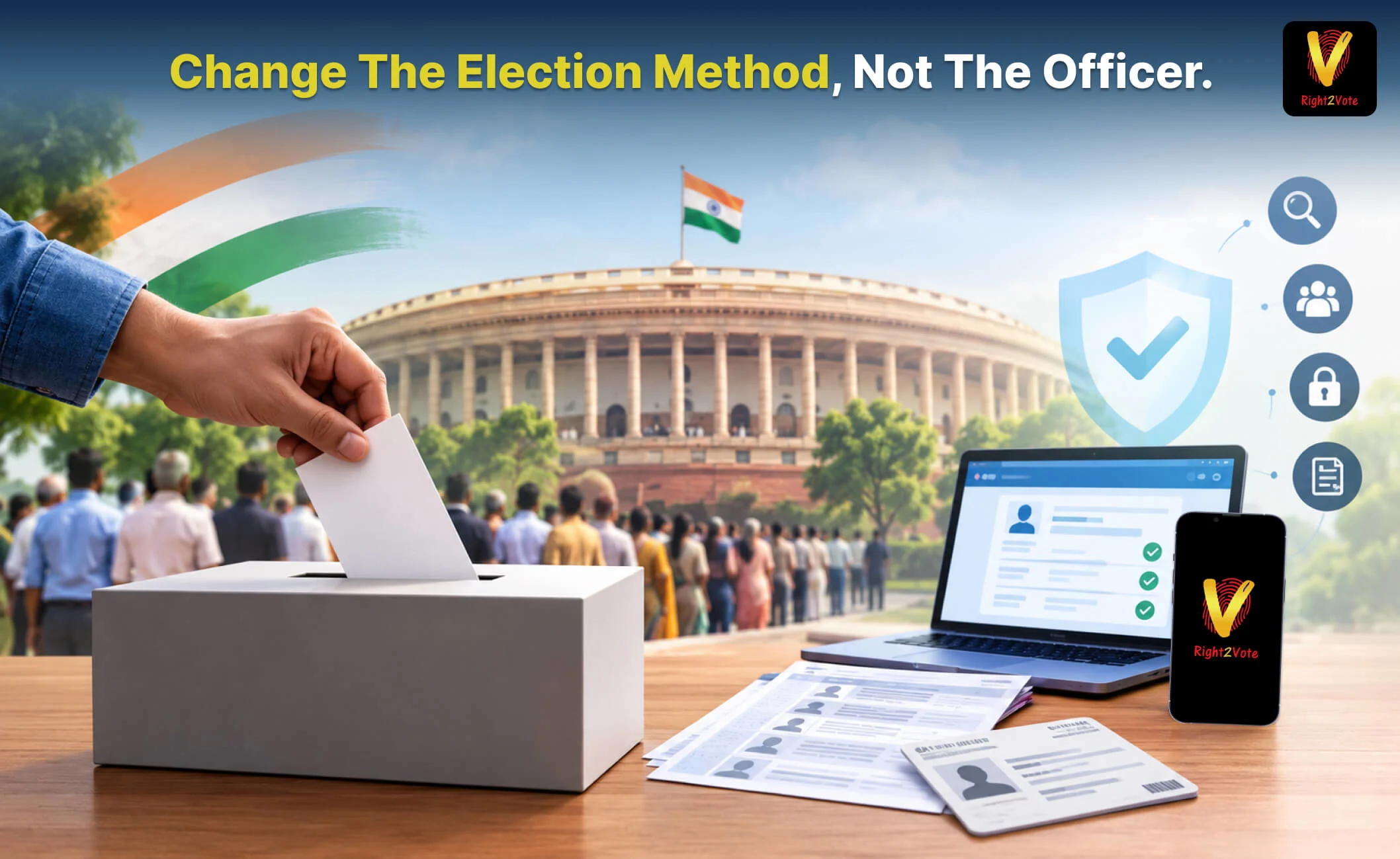
Change The Election Method, Not The Officer
Introduction: Why Are People Demanding Change?
India is the world’s largest democracy, where elections give citizens the power to choose their representatives. However, elections have increasingly become the subject of public debate, political allegations and demands for accountability. Issues such as “Vote Chori,” the Special Intensive Revision (SIR) of electoral rolls and demands for the resignation of Chief Election Commissioner Gyanesh Kumar have sparked protests and political discussions across the country.
The opposition and various political groups have raised questions about electoral transparency, voter list revisions and the functioning of the Election Commission of India. Their concerns have brought an important question into the national conversation: How can we make elections more transparent, accessible and trustworthy?
Perhaps the change India needs is not simply a change in the election officer, but a fundamental improvement in the election method itself.
Instead of limiting the discussion to individuals and political parties, we should focus on building an election system that provides greater transparency, accountability and convenience to every eligible voter.
Understanding SIR: Why Is Voter List Revision Necessary?
The Special Intensive Revision, commonly known as SIR, is a process undertaken to review and update electoral rolls. Its objective is to ensure that voter lists are accurate and contain the names of eligible citizens.
Over time, electoral rolls can contain duplicate entries, the names of deceased individuals, outdated addresses and other inaccuracies. There can also be questions about the eligibility of certain individuals. An accurate voter list is essential because elections depend on ensuring that eligible citizens can exercise their voting rights.
SIR is not an entirely new concept in India. Electoral roll revisions have taken place in the past, although the scope, procedures and circumstances may differ from one revision to another.
However, the implementation of SIR must be fair, transparent and accessible. A genuine voter should not lose their voting rights because of administrative errors, a lack of awareness or difficulties in providing documents.
The verification process must provide sufficient opportunities for people to establish their eligibility. Notices, verification procedures, claims, objections and appeals should be communicated clearly, with adequate time for affected individuals to respond.
It is also important to understand that the absence of a response or a missing document should not automatically be treated as proof that someone is ineligible without following the applicable legal process.
A strong electoral system needs both accurate voter lists and safeguards that protect eligible voters.
The real question is not whether voter lists should be verified, but whether the verification process is accurate, transparent and accessible to everyone.
Technology could help improve this process by making voter information easier to verify, providing digital status updates and allowing citizens to track corrections and applications. However, any technology used for voter verification must comply with election laws, protect personal data and provide alternatives for people who cannot use digital services.
Understanding the Allegations of Vote Chori
The term “Vote Chori,” or vote theft, has become a prominent political expression in discussions about election integrity. Political parties and leaders have raised allegations concerning voter lists, electoral processes and the fairness of elections.
Such allegations deserve to be examined seriously. At the same time, allegations must be distinguished from proven irregularities. Any specific claim should be investigated using credible evidence and the appropriate legal and electoral procedures.
India has witnessed elections in which different political parties have won in different states. The outcomes of elections in Kerala, Tamil Nadu, Bihar, West Bengal and other states demonstrate that political competition produces different results across regions and election cycles. However, an election result by itself neither proves nor disproves a specific allegation of electoral malpractice.
Similarly, the fact that a party loses an election does not automatically mean that the election was unfair. Nor should a complaint be dismissed merely because the complainant belongs to a losing party.
What matters is whether concerns can be investigated independently and whether the findings can be examined through a transparent process.
Under the existing electoral framework, candidates and political parties have specific procedures and deadlines for raising election-related grievances. These procedures vary according to the nature of the complaint and formal election petitions are subject to statutory requirements.
If a party or candidate suspects irregularities, it should submit the available evidence through the appropriate channel. Election authorities should examine valid complaints, explain their findings and take corrective action wherever necessary.
But there is a larger question we must ask: Can we design an election system in which irregularities are easier to detect, records are easier to verify and accountability does not depend entirely on political accusations?
That is where election reform becomes essential.
Is Changing the Election Commissioner Enough?
Whenever controversies arise around elections, demands for the resignation of election officials can become part of the political debate. The current controversy involving Chief Election Commissioner Gyanesh Kumar is an example of how electoral disagreements can turn into questions about individual accountability.
Accountability is necessary in every democratic institution. Election officials must act according to the law, remain impartial and ensure that electoral procedures are administered fairly. Any substantiated misconduct should be addressed through the appropriate constitutional and legal mechanisms.
However, replacing an individual does not automatically resolve weaknesses in the system.
If voter verification is difficult to audit, replacing the officer will not necessarily solve that problem. If complaints are difficult to investigate, changing the leadership alone will not make the process transparent. If voters face unnecessary barriers to casting their ballots, a new officer will not automatically remove those barriers.
A system that relies heavily on individual discretion without sufficient transparency can continue to face similar questions, regardless of who is in charge.
Therefore, India needs to discuss institutional reforms alongside individual accountability.
We should ask for better audit mechanisms, clearer procedures, stronger safeguards, accessible voting options and verifiable records of election-related activities.
Instead of asking only who should conduct elections, we should also ask how elections should be conducted.
The Missing Link: A Transparent Post-Election Audit
One of the most important areas of election reform is the verification of results after voting has concluded.
A credible election system should not merely announce the winner. It should also have robust procedures for verifying that the announced result follows from the votes lawfully cast and counted.
India already has several safeguards for election integrity, including procedures involving polling agents, counting, election records and legal challenges. Electronic voting machines also have established verification and auditing procedures. These existing safeguards should be strengthened where evidence identifies gaps.
The opportunity is to make election records more accessible for authorised scrutiny without compromising ballot secrecy or voter privacy.
For example, an effective audit framework could include:
- A clear record of the number of eligible voters, votes cast and votes counted.
- Reconciliation of voter participation records with the final count.
- Documented procedures for investigating discrepancies.
- Independent verification and appropriate access for authorised observers.
- Secure retention of election records for scrutiny and legal proceedings.
- Clear timelines and procedures for resolving valid complaints.
Digital records can help support these objectives, but digitisation alone is not a guarantee of transparency. A digital system can also contain errors or be manipulated if it is poorly designed or inadequately secured.
Therefore, an electronic or online voting system must have independent security assessments, meaningful audit trails, strong access controls, privacy safeguards and a reliable method of verifying the final result.
The goal should be to make election results verifiable through evidence rather than dependent on trust alone.
Can Online Voting Be the Next Step for Indian Democracy?
India has already demonstrated its ability to build large-scale digital public services. Digital payments, online government services and digital identity infrastructure have changed how millions of people interact with institutions.
Could voting also benefit from carefully designed digital solutions?
Online voting, remote voting and digital booth voting offer possibilities worth exploring. They could make voting more convenient for eligible citizens who face geographical, physical or logistical barriers to reaching a polling station.
However, nationwide online voting for public elections is a complex challenge. It requires more than developing an application or allowing voters to log in with an OTP. Any proposal must meet strict requirements for secrecy, authentication, accessibility, cybersecurity, verifiability and resistance to coercion.
With appropriate safeguards and independent evaluation, digital voting could become an important part of India’s future election infrastructure.
How Could Digital Voting Improve Accessibility?
Remote voting: Eligible voters could potentially cast their ballots from approved remote locations, subject to the applicable legal framework and security requirements.
Any-booth voting: A voter could cast their vote at an authorised polling location other than their designated booth, where the election system supports secure cross-location verification.
Digital booth voting: Voters who are uncomfortable using mobile applications could vote through supervised digital terminals at authorised voting centres.
Accessible voting options: Senior citizens, persons with disabilities, people living far from their registered constituencies and eligible voters who travel for work could benefit from better-designed voting arrangements.
Mobile-friendly interfaces: A simple and accessible interface could help people understand the ballot and navigate the voting process more easily.
Different groups need different solutions. Mobile voting may suit some citizens, while supervised booths, postal ballots or other legally approved arrangements may be more appropriate for others.
The objective should not be to force everyone to vote digitally. It should be to make voting more accessible without weakening its security.
How Can Digital Voting Address Vote Chori and SIR Concerns?
A well-designed digital election system could help address some of the concerns associated with voter verification and election transparency.
Stronger Voter Verification
A digital system could connect eligible voter records with an authorised verification process. Depending on the legal framework, this could involve approved identity checks, secure databases and verification of voter eligibility.
OTP verification, biometric authentication or other identity checks may be considered as components of such a system.
The system must also provide alternatives for people who lack access to a particular device, have connectivity problems or cannot complete a biometric check.
Better Digital Audit Trails
A digital voting system could maintain secure records of authorised actions, system events and vote totals. These records could help investigators identify discrepancies and establish what happened during an election.
However, protecting ballot secrecy is essential. An audit trail must not reveal how an individual voted or create a record that enables anyone to link a voter’s identity to their ballot.
The final result should be independently verifiable and the system should include appropriate safeguards against tampering, unauthorised access and data manipulation.
Faster Complaint Resolution
A digital platform could provide complaint registration numbers, status tracking, document submission and notifications about the progress of a grievance.
This would help voters and candidates follow the process more easily. It could also encourage authorities to maintain clearer records of how complaints were received and resolved.
Digital records would not eliminate every dispute, but they could make investigations more systematic and evidence-based.
Right2Vote: An Existing Example of Digital Election Technology
India already has organisations providing digital election solutions for elections inside and outside the India.
These applications demonstrate how digital election technology can support organisations that need to conduct voting among members who may be located in different places.
Depending on the election’s requirements, digital voting can offer features such as voter authentication, secure ballot access, electronic records and result management. Such capabilities can make the process more convenient and easier to administer.
Nevertheless, experience in organisational elections does not automatically establish that a platform is ready for nationwide public elections. Government elections involve a different scale, legal framework, threat environment and set of constitutional obligations.
Any system proposed for public elections would require appropriate legal authorisation, independent testing, extensive security evaluation, public scrutiny and safeguards that meet the standards of democratic elections.
The broader lesson is that India can learn from existing digital election implementations while carefully evaluating what is required for public elections.
Conclusion: Change the Method, Strengthen Democracy
India needs an election system that inspires confidence among voters, political parties and institutions. Discussions about SIR, Vote Chori allegations and the Election Commission should lead to constructive reforms rather than remain limited to political arguments over individuals.
Accurate voter lists are important. Accountability is important. Fair investigations are important. But so are transparent procedures, verifiable results, accessible voting options and independent audits.
Digital voting could contribute to this transformation, provided it is introduced responsibly and supported by strong security, privacy and verification mechanisms. It is not a magic solution, nor should it replace existing safeguards without convincing evidence that it can meet or exceed them.
The real objective is to create an election system in which eligible citizens can vote conveniently, their votes remain secret and the final results can be independently verified.
Yes, we need a change. Not merely a change in the election officer, but a continuous improvement in the election method itself.
Because democracy becomes stronger not when people are simply told to trust the system, but when the system gives them sound reasons to trust it.
To know more about Right2Vote’s election technology, please refer:
- Government of India certificates
- Features for eVoting
- Security and safety
- Pricing
- Our customers
- Contact Us
 NOTA Never Wins: What Is NOTA in Indian Elections?
 How to Conduct an AGM Online: A Complete Guide to Online Meetings and Voting
 Digital Nomination: Making Election Nominations Simple, Accessible and Efficient