RWA E-Voting in Maharashtra: A New Era of Digital Society Governance
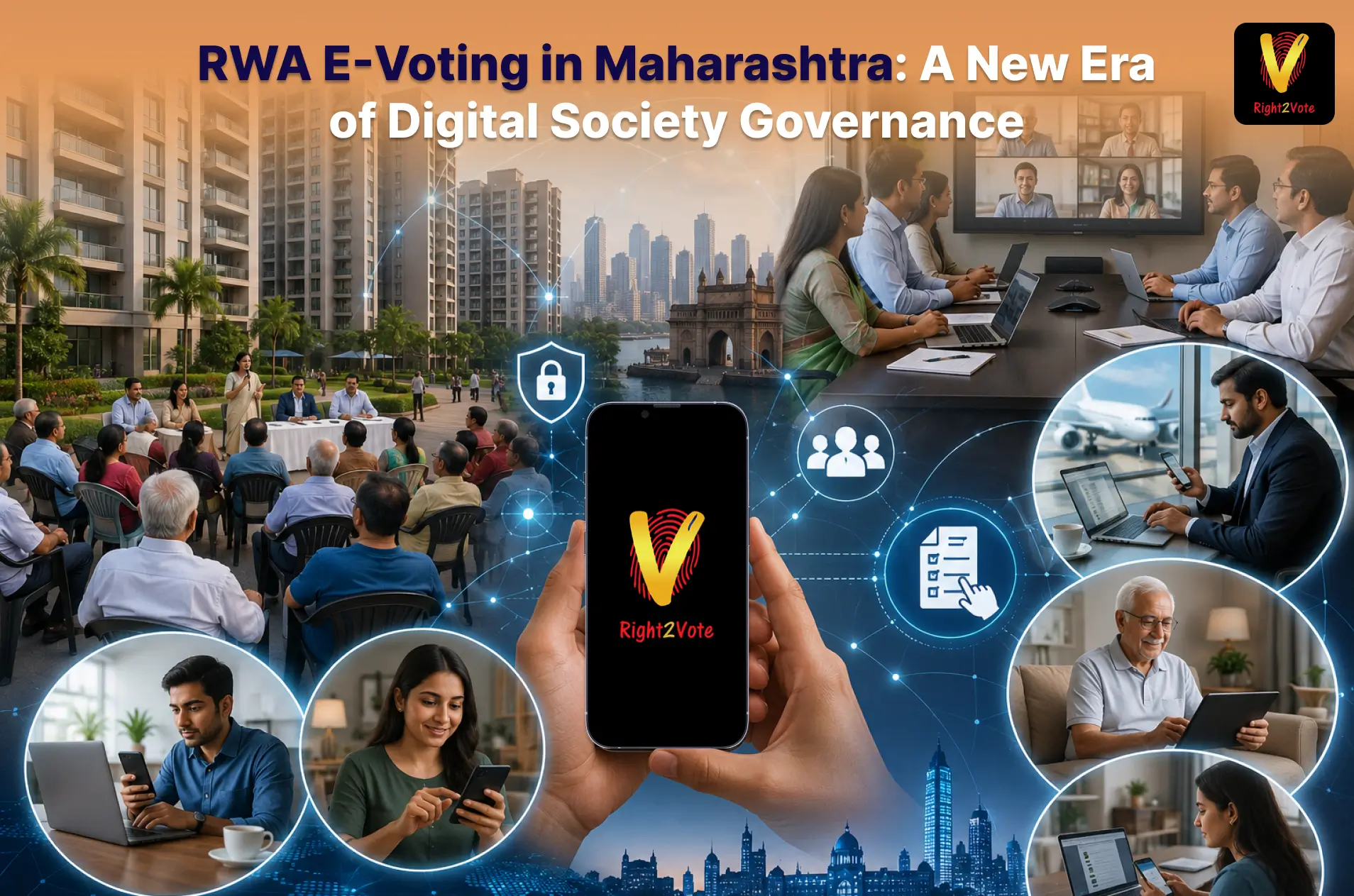
Maharashtra has taken a major step toward modern society governance by legally recognising E-Voting and EAGM (Electronic Annual General Meetings) for housing societies, RWAs and cooperative societies. This decision is extremely important because Maharashtra has more than 1.3 lakh cooperative housing societies and RWAs. For many years, societies struggled with physical meetings, low member participation, vote counting disputes, management issues and confusion regarding online governance. Now, the government has officially accepted digital participation and online voting, which opens a completely new future for society management.
The biggest advantage is simple: members no longer need to be physically present to participate in society governance.
A member sitting in office, working abroad, travelling to another city or living away from the society can now attend meetings, discuss resolutions and vote digitally from anywhere.
This is the future of RWA and housing society management in Maharashtra.
Maharashtra Legalises E-Voting and EAGM for Cooperative Societies
Recently, Maharashtra cleared revised cooperative society rules that officially recognise:
- Digital AGMs
- Hybrid AGMs
- Virtual participation
- Online voting
- Digital governance systems
This move is aimed at modernising the governance system of cooperative housing societies and reducing long-standing operational problems.
For years, many housing societies wanted to conduct online voting and digital meetings, but committee members were unsure whether it was legally valid. There was confusion regarding compliance, transparency, and security.
Now, Maharashtra has provided legal clarity.
This means societies can confidently adopt:
- E-Voting
- Online elections
- Digital resolutions
- Virtual AGMs
- Hybrid meetings
- Online member participation
This decision is especially important because Maharashtra has one of the largest cooperative housing ecosystems in India.
E-Voting and EAGM solve this practical problem because members can now participate from anywhere using their mobile phones or laptops.
Many committee members still hesitate to adopt digital voting because they fear technology. They think online systems may be difficult to manage or insecure. Some worry about manipulation, while others feel senior citizens may not understand the process. However, the reality is that modern E-Voting systems are designed specifically to make the process easy and secure. Today, almost everyone uses OTP verification for banking, UPI payments, online shopping and railway bookings. E-Voting works in a similar secure manner. Members receive a secure link through SMS or email, verify themselves through OTP and then cast their vote digitally. The process is simple, transparent and much easier than standing in long queues during physical voting.
Why This Change Matters for RWAs and Housing Societies
Most cooperative societies face similar problems during elections and AGMs:
- Low attendance
- Members unavailable physically
- Arguments during meetings
- Manual vote counting errors
- Delayed results
- Lack of transparency
- Disputes between members
- Management burden on committee members
Traditional physical voting systems are time-consuming and difficult to manage, especially in large societies where hundreds or thousands of members are involved.
One of the biggest problems in physical AGM meetings is member attendance. In many societies, meetings are delayed because quorum is not completed. Committee members repeatedly request residents to come downstairs and attend meetings. Sometimes meetings are postponed multiple times due to insufficient participation. With EAGM, this problem reduces significantly because members can join digitally from anywhere. Even people travelling for work or sitting in traffic can join through mobile devices. This increases participation and makes governance more democratic.
As a result, many important society decisions are taken with very low participation.
Physical voting also creates unnecessary operational stress for committee members. They need to arrange chairs, halls, registration desks, ballot papers, attendance sheets, counting teams, security arrangements and manual supervision. After voting, committee members often spend hours counting ballots manually. If even one member raises objections regarding counting, arguments begin immediately. Sometimes disputes continue for weeks because people question the transparency of the process. In many societies, elections create tension between groups and residents. Digital E-Voting removes most of these problems because votes are counted automatically by the system without human intervention. Results are generated instantly, which reduces disputes and increases trust among members.E-Voting and EAGM solve this problem completely.
Why Many Society Committees Still Fear Digital Voting
Even after legalisation, many committee members still hesitate to adopt E-Voting systems.
The biggest reason is fear.
Committee members often think:
- What if the system fails?
- What if voting is manipulated?
- What about security?
- Will members understand the technology?
- How will we manage digital elections?
- Is online voting legally safe?
- How are results generated?
These fears are natural because many societies have never used digital governance systems before.
But modern E-Voting platforms like Right2Vote are designed specifically to solve these concerns.
Professional E-Voting agencies provide:
- OTP verification
- Encrypted voting
- Audit trails
- Automated result generation
- Attendance tracking
- Transparent reporting
- Technical support
Once societies conduct their first digital AGM or election, they usually realise that it is easier, faster and more transparent than physical processes.
How to Set Up E-Voting and EAGM for RWAs and Housing Societies
Many societies think digital voting is complicated, but the process is actually very simple.
Step 1: Announce the AGM or Election
The society first announces:
- AGM date
- Election date
- Resolution details
- Participation instructions
Members should receive advance notice through:
- SMS
- Society notice boards
Transparency starts from proper communication.
Step 2: Prepare Nomination or Resolution Draft
If elections are being conducted:
- Candidate nominations are collected
If resolutions are being passed:
- Draft resolutions are prepared clearly
Members must know:
- What they are voting for
- Candidate details
- Resolution details
- Voting timelines
Step 3: Prepare Updated Member/Voter List
This is the most important step.
The society must prepare an updated member database containing:
- Member names
- Mobile numbers
- Email IDs
- Flat numbers
- Voting eligibility
Without proper contact details, digital participation becomes difficult.
A clean voter list ensures:
- Correct invitations
- OTP verification
- Secure participation
- Accurate voting records
Step 4: Select an Experienced E-Voting Agency
Choosing the right E-Voting partner is extremely important.
Societies should select agencies that have:
- Experience in housing society and RWAs elections
- Strong security certifications
- Technical expertise
- Large election handling experience
- Audit systems
- Legal compliance understanding
Right2Vote has:
- More than 11 years of experience
- Conducted over 21,500 elections
- Conducts around 3,000 elections annually
- STQC certification
- ISO certification
- MCA-approved platform
- Experience in cooperative society elections and EAGMs
This gives confidence to societies that the election process is secure and professionally managed.
RWAs and Coperative Societies should always choose experienced and certified E-Voting providers who understand cooperative housing society elections. Right2Vote is one such platform that has more than 11 years of experience in E-Voting and EAGM services. The platform has conducted more than 21,500 elections and conducts nearly 3,000 elections annually. It is STQC certified thrice, ISO certified and MCA approved. Do not fall for fake e-voting agencies that display STQC certification without the CQW mark.
Problems with Physical Voting and Traditional AGMs
This entire process solves many real-life problems faced by societies. It saves time because there is no manual counting or paperwork. It reduces management burden because committee members do not need to organize large physical arrangements. It improves transparency because every vote is digitally recorded. It reduces disputes because results are system-generated. It also eliminates problems like invalid ballots, ballot tearing, duplicate voting, and counting mistakes.
For senior citizens, EAGM creates a major convenience. Many elderly residents want to participate in society decisions but face mobility issues. Climbing stairs, walking long distances or sitting in crowded halls becomes difficult. Through digital AGMs, they can comfortably participate from home. Similarly, working professionals who previously ignored society meetings because of office commitments can now join online and actively participate in governance.
How Maharashtra’s Decision Will Transform Society Governance
Maharashtra’s decision to legalize E-Voting and EAGM shows that the government understands the real problems faced by housing societies. Managing physical voting across more than 1.3 lakh societies is extremely difficult and time-consuming. Digital governance is the practical solution for modern urban societies where residents are busy, mobile and digitally connected. The legalization of E-Voting gives societies the confidence to adopt technology without worrying about legal uncertainty.
The future of housing society governance is clearly moving toward digital systems. Just as banking, shopping, ticket booking, and government services became digital over time, society governance is also evolving. Members today expect convenience, transparency, and faster processes. E-Voting and EAGM provide exactly that. Societies that adopt these systems early will experience smoother governance, better participation, reduced conflicts, and more efficient management.
Why Right2Vote is a Strong Solution for RWAs and Housing Societies
Right2Vote is helping societies move toward this digital future by providing secure and user-friendly E-Voting and EAGM solutions. Many RWAs, housing societies and cooperative societies prefer Right2Vote because of its strong security systems, simple voting process, certifications and large-scale election experience. For societies that are unsure about digital governance, working with an experienced platform reduces fear and makes the transition easier.
Maharashtra’s legalization of E-Voting and EAGM is not just about technology. It is about making society governance more inclusive, transparent, and practical for modern life. Today, members no longer need to be physically present to have a voice in society decisions. Whether they are sitting in office, travelling abroad, or living away temporarily, they can now participate in society governance from anywhere. This transformation will change the way RWAs and housing societies function in the coming years and create a more connected and democratic society management system.
Conclusion
The legalisation of E-Voting and EAGM in Maharashtra is a revolutionary step for RWAs and cooperative housing societies.With more than 1.3 lakh societies in the state, digital governance can dramatically improve participation, transparency and operational efficiency.
Physical voting and traditional AGMs have many limitations:
- Low attendance
- Manual errors
- Disputes
- Delays
- Management burden
E-Voting solves these challenges by allowing members to participate securely from anywhere in the world.
Whether a member is:
- At office
- Travelling
- Living abroad
- Unable to attend physically
They can still participate actively in society governance. This is the future Maharashtra has now officially recognised.
And platforms like Right2Vote are helping societies move confidently toward this digital future with secure, transparent and user-friendly E-Voting and EAGM solutions.
To know more about Right2Vote’s election technology, please refer:
Types of elections :
Important links :
Recent Blogs :
-
 Digital Nomination: Making Election Nominations Simple, Accessible and Efficient
-
 How ISBAA Conducted a Secure and Transparent Online Senate Election with Right2Vote
-
 Finding It Difficult to Conduct Elections? Make Elections Simple with Right2Vote
-
 The Future of Secure Online Voting: Why Right2Vote Outperforms Traditional Paper Elections