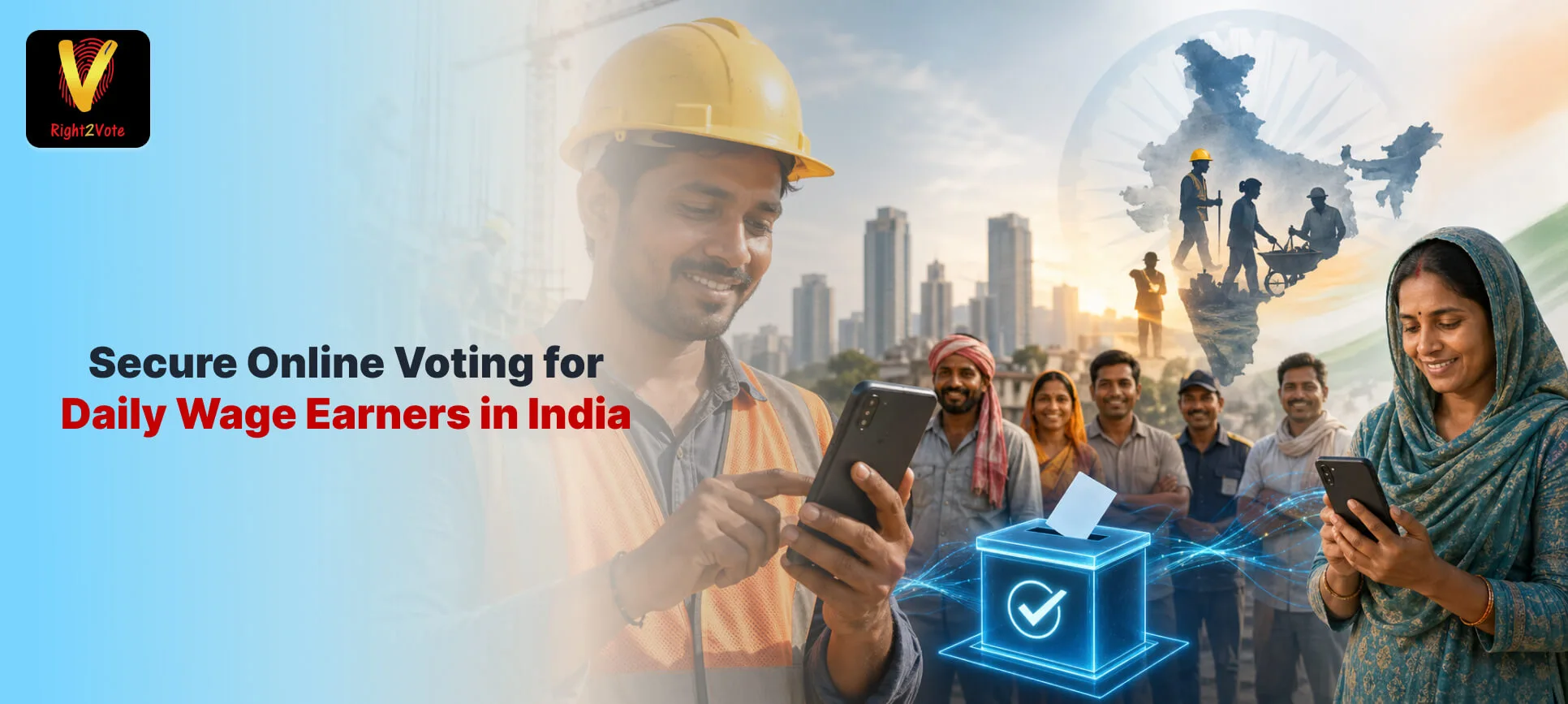
Secure Online Voting for Daily Wage Earners in India
Daily wage earners are among the most hardworking yet underserved sections of society when it comes to electoral participation. They contribute significantly to the economy by working in construction, factories, markets, transportation, and various informal sectors. Despite their importance, their participation in elections remains low due to practical and financial constraints. For them, every working day directly impacts their ability to afford food, shelter, and basic necessities. Missing even a single day of work can create immediate hardship.
At the same time, a large percentage of these workers are migrants, moving from their hometowns to cities in search of employment. When elections take place, they often find themselves far away from their registered constituencies. This creates a serious gap in democratic participation. Secure online voting presents a powerful opportunity to address this issue by making voting accessible, flexible, and practical for daily wage earners without disrupting their livelihoods.
Who Are Daily Wage Earners?
Daily wage earners are individuals who earn income on a per-day basis, without the security of fixed salaries or long-term employment contracts. This group forms a major part of India's informal workforce and includes millions of people working across different sectors. Their income depends entirely on whether they are able to work on a given day, making consistency of work essential for survival.
This category includes construction workers, factory laborers, street vendors, agricultural workers, helpers, drivers, and various skilled and unskilled workers. Many of them migrate from rural areas to urban centers in search of better opportunities. While they contribute significantly to infrastructure development and economic growth, their mobile nature often disconnects them from civic processes like voting. Their daily struggle for income makes it difficult to prioritize activities that do not provide immediate financial return, even if those activities are as important as voting.
Many of these workers migrate from rural areas to cities in search of better income opportunities. While their work supports urban growth and economic development, their mobility creates a disconnect from their voting rights.
The Reality: Why Daily Wage Earners Miss Voting
For daily wage earners, the decision to vote is often overshadowed by the need to earn a living. Elections in India are conducted on fixed dates, requiring voters to be physically present at polling booths located in their registered constituencies. For workers who live far away from their hometowns, this creates a serious challenge. Traveling back to vote is not just inconvenient — it is costly and time-consuming.
- Loss of Daily Income: Taking a day off means no earnings. For many, this is not affordable.
- Travel Challenges: Most workers are registered in their hometowns, often hundreds of kilometers away.
- High Costs: Travel expenses, combined with lost wages, make voting an expensive activity.
- Time Constraints: Elections are held on fixed dates, leaving no flexibility for workers.
- Job Insecurity: In informal sectors, absence can sometimes lead to loss of future work opportunities.
Example: A daily wage worker from Uttar Pradesh working in Delhi may have to spend one or two days traveling back home. This means losing income for multiple days and spending money on travel — something they simply cannot afford. As a result, they choose to continue working instead of voting.
The Hidden Impact on Elections
The absence of daily wage earners from the voting process has a deeper impact than what is immediately visible. When a large segment of the population is unable to participate in elections, it creates a gap in representation. These workers represent the backbone of industries and infrastructure, yet their voices are often missing when decisions are made.
It is estimated that elections can see a 10 to 15 percent drop in voter turnout due to migrant and daily wage worker non-participation. This directly affects the inclusiveness and fairness of the democratic process. Policies and decisions may not fully reflect the needs and challenges of this group. Over time, this leads to reduced engagement and trust in governance. Ensuring their participation is not just about increasing numbers — it is about making democracy truly representative of all sections of society.
When millions of hardworking citizens are unable to vote, democracy loses an important voice.
The Need for a Practical Voting Solution
India has rapidly embraced digital solutions in sectors such as banking, education, and healthcare, making services more accessible and efficient. However, voting still largely depends on traditional methods that require physical presence. For daily wage earners, this system does not align with their realities. A modern workforce that is mobile and time-constrained requires a voting system that adapts to their needs.
A practical solution must eliminate the need for long-distance travel and reduce the time required to vote. It should also be simple enough for individuals with limited technical knowledge to use confidently. At the same time, it must ensure high levels of security, transparency, and trust. Secure online voting addresses all these requirements by allowing voters to participate without leaving their workplace or losing income. It bridges the gap between civic responsibility and daily survival.
This is where secure online voting becomes not just an innovation, but a necessity.
How Online Voting Can Empower Daily Wage Earners
Online voting has the potential to transform electoral participation for daily wage earners by removing the barriers that prevent them from voting. It allows them to cast their vote from any location using a mobile phone or computer, making the process convenient and accessible. This is particularly important for workers who cannot afford to take time off or travel long distances.
- Vote from Anywhere: Workers can vote from their workplace or residence using a mobile device.
- No Travel Needed: Eliminates the need to return to hometowns.
- No Loss of Wages: Voting can be done within minutes, without missing work.
- Flexible Access: Voting windows can be extended to suit different schedules.
- Simple Process: Easy steps make it accessible even for first-time users.
- Higher Participation: Convenience leads to increased voter turnout.
Example: A construction worker can cast their vote during a short break instead of losing an entire day's wage.
Right2Vote: Ensuring Every Worker Can Vote
Right2Vote is built on a simple but powerful belief — no one should be denied their right to vote. The platform is designed to address the exact challenges faced by daily wage earners and migrant workers.
Key Features That Support Daily Wage Earners:
- Secure Authentication: OTP-based login ensures that only authorized voters can participate
- Encrypted Voting: Protects the integrity and secrecy of each vote
- Mobile-Friendly Platform: Works seamlessly on basic smartphones
- Quick Voting Process: Takes only a few minutes to complete
- Scalable System: Can handle elections with large voter bases
- Transparent Results: Real-time monitoring and instant counting
By focusing on security, simplicity, and accessibility, Right2Vote makes voting possible without disrupting a worker's daily life.
Hybrid Voting: A Flexible Approach
While online voting offers significant advantages, it is important to recognize that not all individuals may be ready to adopt digital systems immediately. A hybrid voting model provides a balanced approach by combining online and traditional methods. This ensures that every voter has the option to choose the method they are most comfortable with.
In a hybrid system, daily wage earners who are away from their hometowns can vote online, while others can continue using physical polling booths. This flexibility helps increase overall participation without forcing a sudden transition. It also builds trust in digital systems over time, encouraging gradual adoption. By accommodating different preferences and access levels, hybrid voting ensures inclusivity and smooth implementation, making it an effective solution for diverse populations.
Why This Matters for India
India's democratic strength depends on the participation of its citizens from all walks of life. Daily wage earners represent a significant portion of the population and contribute immensely to the country's growth and development. Ensuring their participation in elections is essential for creating a fair and representative system.
When these workers are included in the voting process, policies are more likely to address their needs and challenges. It also strengthens trust in governance, as citizens feel their voices are heard. Inclusive participation leads to better decision-making and more balanced development. By making voting accessible to daily wage earners, India moves closer to a democracy that truly represents all its people — not just those with the means and time to vote.
The Future of Voting for Workers
As technology continues to evolve, the future of voting in India is likely to become more flexible and inclusive. Digital platforms and mobile connectivity have already transformed many aspects of daily life, and voting is expected to follow a similar path. Secure online voting systems are gradually gaining attention as a practical solution to increase participation.
In the coming years, there may be wider adoption of remote and hybrid voting models, especially for populations that face mobility challenges. This will help bridge the gap between traditional systems and modern needs. Increased participation from daily wage earners and migrant workers will lead to more representative elections and stronger democratic processes. The future lies in creating systems that are not only secure but also accessible to every citizen, regardless of their circumstances.
Final Thoughts: Every Day's Work Matters, Every Vote Matters
Daily wage earners dedicate their time and effort to building and sustaining the nation's economy. Their work ensures the functioning of cities, industries, and essential services. However, their participation in shaping the country's future through voting remains limited due to practical challenges. This is a gap that needs urgent attention.
No individual should have to choose between earning a livelihood and exercising their right to vote. With the help of secure online voting solutions like Right2Vote, this challenge can be addressed effectively. The goal is to create a system where voting is accessible, convenient, and inclusive for everyone. When every worker is given the opportunity to vote, democracy becomes stronger, fairer, and more representative. Because in the end, every day's work matters — and so does every vote.