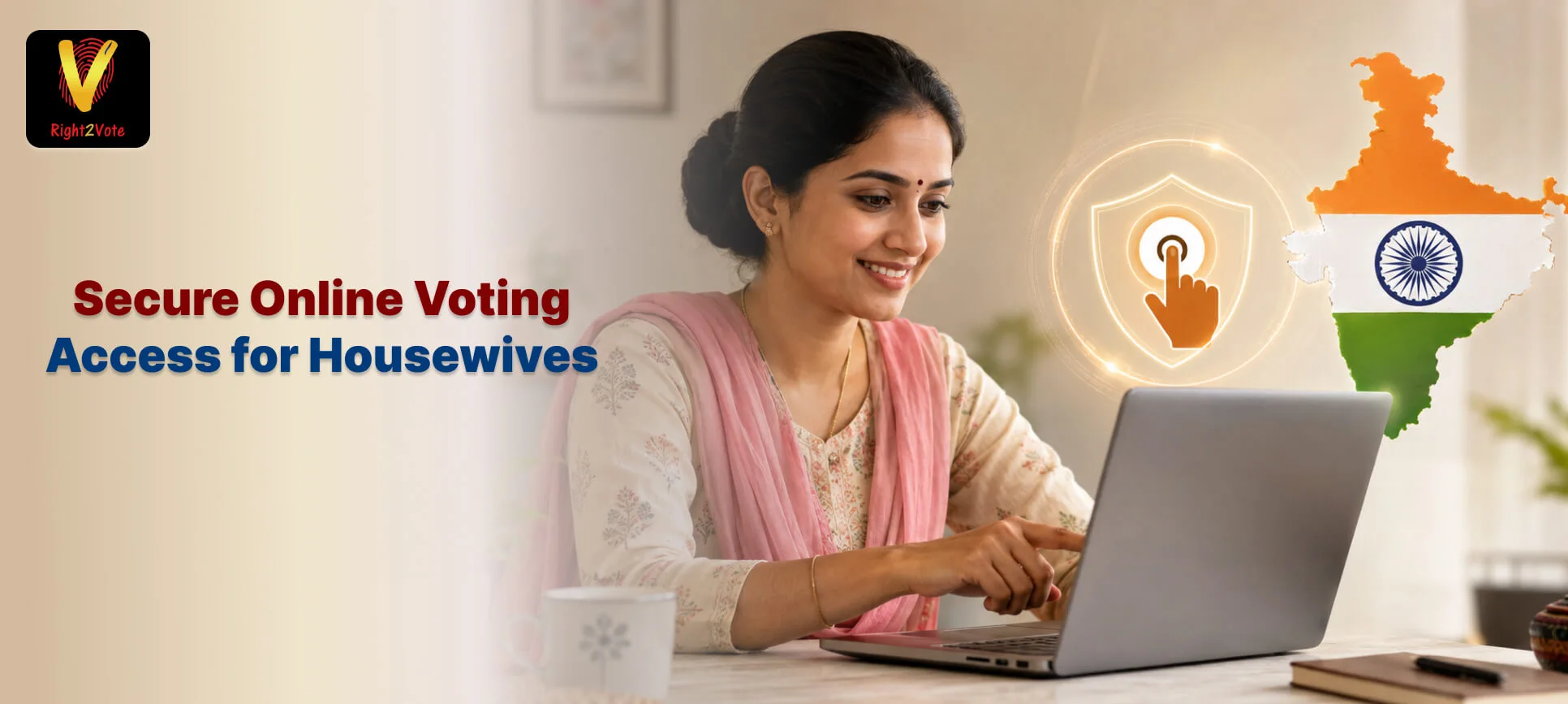
Secure Online Voting Access for Housewives in India
In India, housewives play a powerful yet often under-recognized role in shaping families, communities, and society. They manage households, raise children, support working members and handle countless responsibilities every day. Despite not always being part of the formal workforce, their contribution to the nation's social and economic fabric is immense.
However, when it comes to elections like the Indian General Elections of India, many housewives are unable to cast their vote. One of the biggest reasons is migration after marriage or relocation due to family responsibilities. In India, it is very common for women to move from their hometown to their husband's home after marriage. In many cases, their voter registration remains in their original constituency, while they are living in a completely different city or state. On election day, going back to their hometown just to vote is not always possible.
This results in a large number of women silently missing out on voting. Not because they are unaware or uninterested — but because the system does not easily support their situation. This gap needs attention, as empowering women voters is essential for a strong and inclusive democracy.
Understanding Why Many Housewives Are Away from Their Constituency
The issue of housewives missing voting is deeply connected to social and family structures in India. Unlike many other voter groups, their mobility is often influenced by life events rather than professional choice.
- Marriage-Based Relocation: After marriage, many women move to a new city or village. However, updating voter registration immediately is not always done due to lack of awareness, documentation issues or time constraints.
- Family Responsibilities: Housewives are often responsible for managing children, elderly family members and household duties. Traveling alone or leaving responsibilities behind just for voting may not be practical.
- Dependence on Family Logistics: In many cases, travel decisions depend on family planning. If other family members are not traveling to the hometown, the woman may not be able to go alone.
- Cultural and Social Barriers: In some households, voting may not be given priority, especially if it involves travel or additional expense.
- Temporary Living Situations: Some housewives stay in rented homes or temporary locations due to their spouse's job. This makes voter registration updates even more complicated.
Because of these reasons, many housewives remain registered in one place but live in another — creating a major barrier on election day.
Challenges Housewives Face in Traditional Voting
Traditional voting systems require physical presence at a designated polling booth. For housewives living away from their registered constituency, this creates multiple challenges.
- Travel Distance and Cost: Returning to their hometown may require long-distance travel, which involves time, money, and planning.
- Household Responsibilities: Managing children, meals, and family needs makes it difficult to take time off for travel.
- Lack of Immediate Support: Not all women have support systems that allow them to leave home for a day or more.
- Limited Awareness of Transfer Process: Many are not fully aware of how to transfer voter registration or find the process complicated.
- Time Constraints: Election dates are fixed, leaving no flexibility for planning travel.
Example: A woman from Rajasthan married and living in Delhi may still be registered in her hometown. On election day, she cannot travel back due to family responsibilities, and thus misses voting. These challenges lead to a significant number of women being underrepresented in elections.
The Impact of Low Participation by Women
When housewives and women voters are unable to participate, it affects the balance of representation in democracy.
- Women's issues may not be fully represented
- Policies related to family welfare, healthcare and education may lack perspective
- Decision-making becomes less inclusive
- Gender participation gap increases
Housewives bring valuable insights into daily life challenges, community needs and family priorities. Their participation is crucial for balanced governance. Low turnout among women is not just a statistical issue — it reflects a gap in accessibility. Ensuring their participation strengthens both democracy and social equity.
The Need for Flexible and Inclusive Voting Solutions
India has made progress in empowering women in many areas, but voting systems must also evolve to match their realities. A modern voting system should:
- Allow voting without long-distance travel
- Be simple and easy to use
- Provide flexibility in timing
- Ensure safety and privacy
- Be accessible to all education levels
Such a system would remove the barriers that currently prevent many housewives from voting. It would also encourage higher participation and awareness. This is where digital solutions like online voting and hybrid models can make a significant difference.
How Online Voting Can Help Housewives
Online voting directly addresses the key challenges faced by housewives by removing the need for physical presence.
- Vote from Home: Housewives can vote without leaving their home, making it convenient and safe.
- No Travel Required: Eliminates the need to return to the hometown constituency.
- Flexible Timing: Voting can be done at a convenient time during the day.
- Easy Process: Simple steps make it accessible even for first-time users.
- Secure and Private: Modern systems ensure confidentiality and data protection.
Example: A woman living in Mumbai but registered in her hometown in Uttar Pradesh can vote online without traveling, while managing her household responsibilities. Online voting empowers women by giving them control over their participation.
Digital Booth Voting: A Practical Alternative
In situations where full online voting is not implemented, digital booth voting offers a balanced solution. This model allows:
- Voting from nearby authorized centers instead of original constituency
- Digital verification of voter identity
- Secure access to ballots through connected systems
- Faster and smoother voting experience
For housewives, this means they can vote from a nearby location without traveling long distances. It also maintains the trust and structure of traditional voting while adding flexibility.
Right2Vote: Empowering Every Woman's Voice
Right2Vote is committed to the idea that no one should be denied their right to vote due to personal or logistical challenges. Its eVoting platform is designed to make voting accessible for all, including housewives.
Key Features:
- Secure Access: OTP-based login and encrypted systems ensure safe voting.
- Simple Interface: Easy-to-use design suitable for all users.
- Mobile-Friendly: Vote using a smartphone from anywhere.
- Transparent Process: Ensures fairness and trust in results.
- Quick Participation: Voting takes only a few minutes.
Right2Vote also supports hybrid voting, combining online and booth-based methods, ensuring inclusivity for all types of users.
Why This Matters for India's Future
Women form a significant portion of India's population. Their participation is essential for a truly representative democracy. When housewives vote:
- Policies become more inclusive
- Social issues get better attention
- Families and communities are better represented
- Democracy becomes stronger
Empowering women to vote easily is not just a convenience — it is a necessity for balanced growth.
Final Thoughts: Every Homemaker, Every Vote
Housewives may not always be visible in public spaces, but their role in shaping society is undeniable. They manage homes, support families, and contribute to the nation in meaningful ways. They deserve equal access to participate in democracy.
Barriers like distance, responsibility, and lack of flexibility should not prevent them from voting. With solutions like online voting and digital booth systems, these challenges can be overcome. Right2Vote is working toward a future where every woman, no matter where she lives, can exercise her right to vote without difficulty. Because in a true democracy, every homemaker's voice matters — and every vote should count.