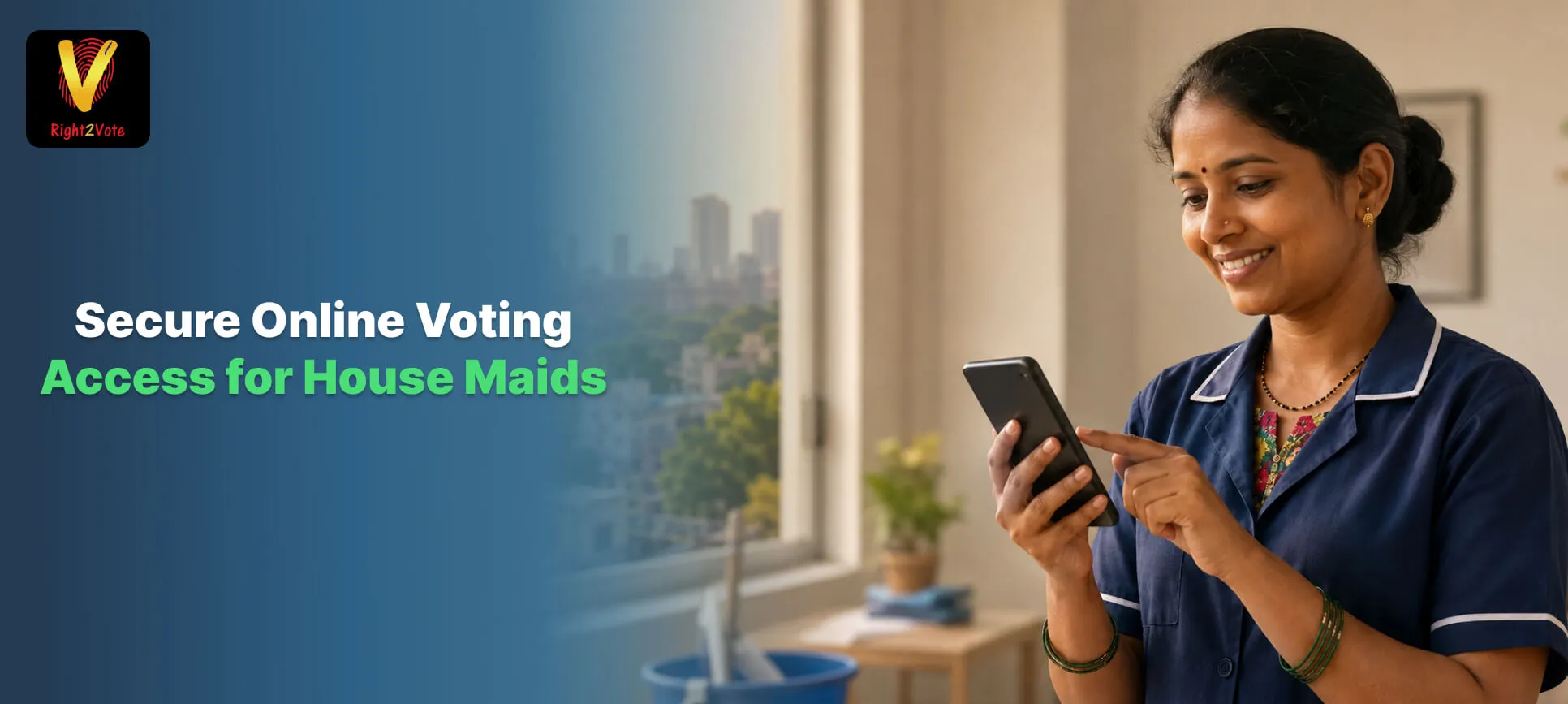
Secure Online Voting Access for House Maids in India
Domestic workers commonly known as house maids are an essential part of urban life in India. They clean homes, cook meals, care for children and the elderly and keep households running smoothly so that others can go to work with peace of mind. A large number of these workers are women who have migrated from villages or small towns to cities in search of livelihood.
Despite their contribution, many domestic workers are unable to participate in elections such as the Indian General Elections of India. The main reason is simple but serious — they are often away from their registered home constituency and tied to daily work commitments. For many, election day is not a holiday. It is a working day where missing work means losing income. Traveling back to their village to vote is expensive and time-consuming. As a result, a large number of domestic workers silently miss their chance to vote.
This is not just a personal loss — it is a democratic gap. These women are part of the workforce that supports urban India, yet their voices are often missing in the system that shapes policies affecting their lives.
Who Are Domestic Workers and Why They Migrate
Domestic workers form a significant part of India's informal workforce. Most of them are women who migrate from rural areas to cities for better income opportunities. Their work includes cleaning, cooking, washing, babysitting and caregiving. Many of these workers move alone or with their families. Some live in shared accommodations, while others stay in their employer's homes. Their migration is driven by financial needs — supporting children's education, healthcare and basic living expenses.
In many cases, their voter registration remains in their native village. Updating it to the city where they work is often not done due to lack of awareness, documentation issues, or frequent job and location changes. This creates a disconnect. They live and work in one place but are registered voters in another. When elections arrive, they are expected to be physically present in their home constituency, which is rarely possible. Their mobility, which helps them earn a livelihood, becomes the biggest barrier to exercising their democratic right.
Why Domestic Workers Miss Voting
Domestic workers face multiple challenges that prevent them from voting in traditional booth-based systems.
- Work Dependency and No Leave: Most domestic workers are paid daily or monthly based on attendance. Missing even one day can lead to wage cuts or job risk. Employers may not always provide leave for voting.
- Migration and Distance: They often work in cities far from their hometowns. Traveling back for voting involves long journeys, high costs, and time away from work.
- Financial Constraints: Travel expenses, food, and lost wages make voting an expensive decision for low-income workers.
- Lack of Awareness About Voter Transfer: Many workers are unaware of how to transfer their voter registration or find the process difficult.
- Household Responsibilities: Even after work, they have their own families to manage. Taking time out for travel becomes even harder.
- Fixed Voting Schedule: Elections are conducted on specific dates, leaving no flexibility for workers with strict job commitments.
Example: A domestic worker from Jharkhand working in Delhi may need to travel for more than a day to reach her village. This means losing wages, spending money and risking her job — so she chooses not to go.
The Impact of Their Absence in Voting
When domestic workers are unable to vote, it creates a gap in representation.
- Issues related to informal labor may not get enough attention
- Policies for worker welfare may lack real ground-level input
- Women's voices from economically weaker sections remain unheard
- Urban-rural migration challenges are underrepresented
These workers understand real-life struggles — housing, wages, safety and healthcare. Their participation can influence better decision-making. Democracy works best when every section of society is represented. When domestic workers are excluded, the system becomes less inclusive.
The Need for Accessible Voting Solutions
India has made progress in digital systems across banking, payments, and services. However, voting still largely depends on physical presence. For domestic workers, a better system must:
- Remove the need for long-distance travel
- Allow voting without losing income
- Be simple and easy to use
- Be accessible through mobile devices
- Ensure safety and privacy
Such a system would empower millions of workers who are currently left out due to practical limitations.
How Online Voting Can Help Domestic Workers
Online voting provides a powerful solution to the challenges faced by domestic workers.
- Vote from Anywhere: Workers can vote from the city where they are working without returning to their hometown.
- No Loss of Income: Voting takes only a few minutes, so they do not need to miss a full day of work.
- No Travel Cost: Eliminates the need for expensive and time-consuming travel.
- Flexible Timing: Voting can be done during a break or after work.
- Simple Process: Easy-to-use platforms make it accessible even for first-time users.
- Secure and Private: Advanced systems ensure that votes are safe and confidential.
Example: A domestic worker finishing her morning work in Mumbai can cast her vote online for her village in her hometown using her phone, without losing wages. Online voting transforms voting from a difficult task into a simple action.
Digital Booth Voting: A Practical Middle Solution
In addition to online voting, digital booth voting can provide a practical alternative. This system allows workers to vote from nearby authorized centers instead of their original constituency. Benefits include:
- Voting from a nearby location
- Digital identity verification
- Secure access to ballots
- Reduced travel time
- Faster and smoother process
For domestic workers, this means they can visit a nearby digital booth in their city and vote without needing to travel long distances. This approach maintains the trust of traditional systems while adding flexibility.
Right2Vote: Ensuring No Worker Is Left Behind
Right2Vote is built on a clear mission: "No one should be denied their right to vote." Its eVoting platform is designed to include workers who face barriers due to distance, time, or job constraints.
Key Features:
- Secure Authentication: OTP-based login ensures only eligible users can vote.
- Mobile-Friendly Platform: Workers can vote using smartphones from anywhere.
- Easy Interface: Simple steps make it accessible for all users.
- Transparent Process: Ensures fairness and trust in elections.
- Quick Voting Experience: Takes only a few minutes to complete.
Right2Vote also supports hybrid voting, combining online and booth-based systems to maximize participation.
Why This Matters for India's Democracy
Domestic workers are a vital part of India's workforce. Their participation in elections is essential for a truly inclusive democracy. When they vote:
- Policies become more inclusive
- Worker welfare gets better attention
- Women's voices are strengthened
- Social equality improves
Empowering them to vote is not just about technology — it is about fairness and dignity.
Final Thoughts: Every Worker, Every Voice
Domestic workers spend their days supporting families and building lives in cities far from home. They contribute silently but significantly to society. They should not have to choose between earning a livelihood and exercising their right to vote.
With solutions like online voting and digital booth voting, this gap can be closed. These systems make voting accessible, affordable, and practical for millions of workers. Right2Vote is working toward a future where no domestic worker is left out of the democratic process. Because in a true democracy, every worker matters — and every vote must count.