West Bengal Election 2026: More Than an Election, A Turning Point for Bengal
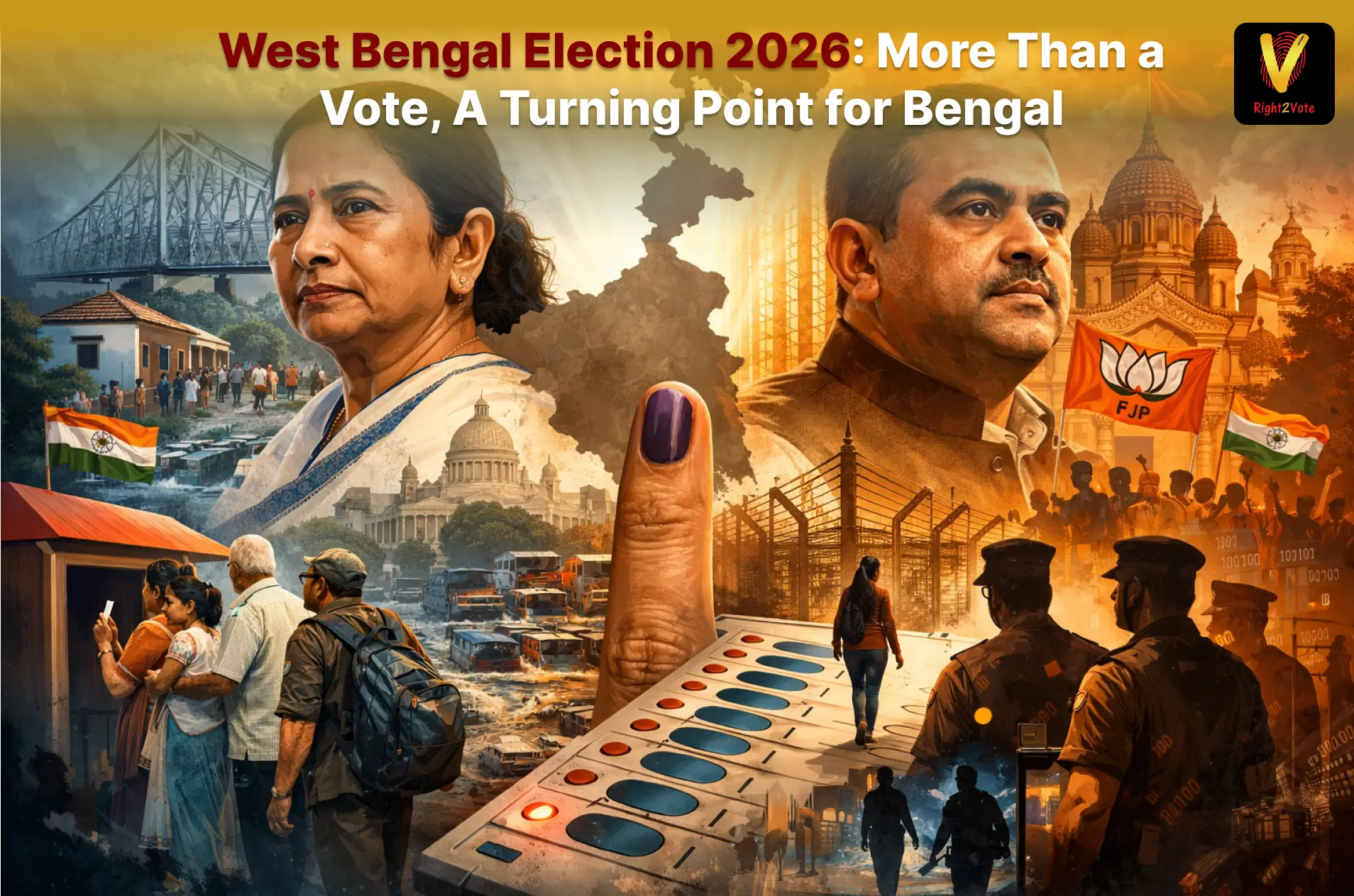
This West Bengal Assembly Election 2026, scheduled for 23 April and 29 April, with counting on 4 May, is not just another election cycle. It is a moment that could redefine the political, social and economic future of the state. For many voters, this election is not about political slogans. It is about everyday life – roads they travel, safety they feel, jobs they struggle to find and the identity of the state they live in.
When people walk into polling booths this year, they are not just choosing a candidate. They are choosing what Bengal should become in the next decade. This election will decide the future direction of West Bengal its development model, governance standards, law and order situation and even its role in the broader national security landscape. This blog explains the key factors shaping the West Bengal Election, including political competition, leadership battles, civic issues, identity narratives, voter challenges, and the role of technology, helping readers understand why this election is crucial for both the state and national interest.
From Political Contest to Public Decision
At the centre of this election is a strong and direct contest between Trinamool Congress (TMC) and Bharatiya Janata Party (BJP). But this rivalry did not start recently; it has been growing for more than 15 years.
In 2011, when TMC first came to power in West Bengal, BJP had very little presence in the state. Over time, things began to change. By 2021, BJP had become the main opposition party, winning many seats and gaining strong support from voters. This change did not happen suddenly. It shows that people’s expectations, political thinking, and priorities have been changing over the years.
Now in 2026, the election has become a clear two-party contest. On one side, TMC stands for continuity, welfare schemes, and strong regional leadership. On the other side, BJP focuses on change, national integration, and governance reforms.
Because both parties offer very different visions for the future, the competition has become more intense. This is why the stakes in this election feel higher than ever, making it an important moment for voters.
The Nandigram Effect: Leadership Battles That Shape Narratives
The “Nandigram Effect” has become one of the most important moments in West Bengal politics. In the 2021 election, Suvendu Adhikari, who was once a senior leader in Trinamool Congress, defeated Mamata Banerjee in Nandigram, her own stronghold. This was not just a simple defeat; it changed the political narrative of the state. It showed that even powerful leaders can face tough challenges, and voters are open to changing their choices based on issues and performance. Now, in 2026, if these two leaders face each other again, it will not just be another election contest but a test of voter memory and political comeback.
Key takeaways from the Nandigram Effect:
- Strong leaders can still be defeated
- Voters are willing to shift loyalties
- Local issues can be more important than party strength
- Elections can reshape political narratives
The big question remains: will history repeat itself, or will voters choose a different outcome this time?
Civic Infrastructure: A Daily Struggle, Not Just a Policy Issue
When we talk about infrastructure, it may sound like a technical or policy-heavy term. But for people in West Bengal, especially in cities like Kolkata, it is something they experience every single day. Problems like waterlogging during heavy rains, constant traffic congestion, and unplanned urban growth are not just government issues, they directly affect people’s lives. These challenges make daily routines more difficult and stressful.
For example:
- Heavy rains lead to waterlogging, making roads unusable
- Traffic jams waste time and reduce productivity
- Poor urban planning creates long-term living issues
- Health issues
These problems directly impact:
- Office workers who arrive late to work
- Students who miss classes
- Small businesses that lose customers
So, when voters hear political parties talk about improving infrastructure, they are not thinking in technical terms. They are thinking about simple, real-life improvements – better roads, less traffic and smoother daily life. Ultimately, their vote is influenced by whether they believe these everyday struggles will actually be solved.
Women’s Safety: A Deciding Factor
Women voters have played a very important role in past West Bengal elections, especially because of welfare schemes that directly benefit them. However, safety remains a deeply sensitive and critical issue. Whenever incidents of crime against women come to light, they quickly turn into major political discussions. These cases often influence public perception more strongly than actual data or statistics.
For most voters, the concern is simple and personal:
- Can women travel safely at night?
- Is the police response quick and effective?
- Are complaints taken seriously without delay?
Even a small number of high-profile incidents can create a strong emotional reaction across the state. These incidents shape how people feel about safety and governance, which directly impacts voting decisions. As a result, women’s safety is not just a social issue, it becomes a major electoral factor that can influence the overall narrative of the election.
Corruption Allegations: Trust vs Loyalty
Over the years, allegations of corruption have appeared in different forms in West Bengal politics. While many voters may not follow every detail, such issues still create a gap in trust. However, the situation is not simple. Many people continue to support Trinamool Congress (TMC) for practical reasons. Welfare schemes have directly helped them, and local leaders often maintain strong personal connections with communities. At the same time, alternatives like the Bharatiya Janata Party (BJP) are still being judged by voters.
Many voters still support TMC because:
- They have benefited from welfare schemes
- Local leaders maintain strong personal connections
- Alternatives are still being evaluated
This creates a conflict in the voter mindset:
- Loyalty vs accountability
- Immediate benefits vs long-term governance
This creates a real conflict in the minds of the voters. On one hand, there is loyalty built over years of support and benefits. On the other hand, there is a growing demand for accountability and clean governance. Voters also weigh immediate benefits against long-term development and stability.
This internal struggle is important. It shows that voting decisions are not always clear-cut. In many cases, this balance between trust, benefit, and expectation could play a key role in deciding the final election outcome.
The Hindu Muslim Factor: Identity, Perception and Political Strategy
The Hindu-Muslim factor in West Bengal politics has become more visible in recent years, especially after the 2019 and 2021 elections. However, it is important to understand that this is not always about direct conflict. In many cases, it is more about perception, identity and political messaging rather than everyday reality.
West Bengal has a unique social fabric, with a significant Muslim population (around 27–30%) and a Hindu majority. For decades, the state maintained a relatively balanced communal environment compared to many other regions of India. But over time, political narratives have started shaping how communities see themselves and each other. Today, the TMC is often perceived as having strong support among Muslim voters, while the BJP is seen as consolidating Hindu votes.
Political parties approach this issue in different ways. TMC focuses on welfare schemes and maintains strong outreach in minority-dominated areas. On the other hand, BJP highlights issues like infiltration, border security and illegal immigration, while positioning itself as a protector of cultural and national identity. These narratives are powerful because they shape how voters interpret local issues and events.
Past incidents have also played a role in strengthening these perceptions. Localized clashes during festivals, tensions during elections and debates over religious processions often receive widespread media attention. Even if such incidents are limited to specific areas, in elections, perception can be just as important as reality.
For voters, this issue is often less about ideology and more about security and identity. Some people worry about cultural preservation and demographic changes, while others are concerned about equality, representation and protection. This creates a situation where different groups feel they are safeguarding their own interests.
However, the key question remains the same: Will religion decide the 2026 election? The answer is not entirely. While identity politics plays a role, elections in West Bengal are still strongly influenced by welfare schemes, local leadership, candidate credibility, and everyday economic concerns. Many voters take a balanced approach, considering both identity and development before making a decision.
At the same time, there is a risk. If this narrative becomes too dominant, it can shift attention away from important issues like jobs, Education, infrastructure, and governance, and may increase social tensions. Ultimately, religion can influence emotions, but it rarely decides elections on its own. Trust and daily life concerns are likely to play a bigger role in shaping the final outcome in 2026. The Hindu–Muslim narrative may influence emotions, but the final decision of Bengal’s voters will likely depend on who they trust more with their future, not just their identity.
The SIR Debate: Cleaning the System or Political Strategy?
The debate around the Special Intensive Revision (SIR) of electoral rolls has become one of the most discussed issues in the current political environment. Reports suggesting that nearly 70 lakh voters could be removed have raised serious questions. It directly affects who has the right to vote, who may be excluded and ultimately, how election results could be shaped.
The main concern among citizens is whether genuine voters might be removed by mistake. Many people worry about errors in verification, missing documents, or administrative lapses that could leave eligible voters out of the system. At the same time, there is another side to the argument. Some believe that these removals are necessary to eliminate duplicate or illegal entries, ensuring that the electoral process remains fair and transparent.
The issue becomes even more sensitive when seen in a larger context. Border districts of West Bengal, especially those close to Bangladesh, have long been part of debates around illegal infiltration and identity verification. Concerns about undocumented migrants and their inclusion in voter lists have been raised for years. This adds a layer of complexity, as electoral roll revisions are now linked with broader questions of national security and demographic balance.
Because of these factors, the SIR exercise is being viewed in two very different ways. For some, it is a necessary step to protect electoral integrity and ensure that only eligible citizens vote. For others, it raises doubts about whether such a large-scale revision could be used as a political strategy to influence voter composition.
In the end, the impact of SIR goes beyond technical corrections. It touches upon trust, fairness, and the very foundation of democratic participation.
If your name is missing, you still have time to register before 9 April 2026 by showing proper documents. After that, the voter list will be frozen.
The Silent Problem: Voters Who Cannot Vote
One of the most overlooked issues in Indian elections is access to voting.
Even today, millions of eligible voters are unable to participate, not because they don’t want to, but because they physically cannot.
Real-Life Situations:
- A worker from Bengal working in Mumbai cannot travel back just to vote
- A student studying in Delhi misses voting due to exams
- An elderly or disabled person cannot stand in long queues
These are not rare cases; they represent a large section of the population.
And every missed vote is a lost voice in democracy.
The Online Voting
Online voting is not allowed in West Bengal Assembly elections, and this often limits participation for many voters. If online voting were introduced, it could solve several real-life problems. For example, a migrant worker could vote from another state, a senior citizen could vote comfortably from home, and a student could participate without missing exams and many more examples where online voting helps. This would make the voting process more convenient and could significantly increase voter turnout.
However, there are serious concerns that cannot be ignored. People worry about whether the system could be hacked, whether votes would remain completely confidential, and whether the process would be truly secure. Another major issue is digital access many rural voters may not have the internet or technical knowledge required for online voting.
Because of these challenges, institutions like the Election Commission of India have taken a cautious approach, prioritizing security and fairness over convenience.
The Role of Technology: A Glimpse into the Future
The role of technology in elections is slowly becoming more important, offering a glimpse into the future of voting. Platforms like Right2Vote show that secure digital voting is not just an idea; it is already being used in controlled environments. These systems are designed to ensure verified voter identity, maintain transparency, and provide a structured and secure voting process.
Such platforms already offer:
- Controlled and monitored voting environments
- Strong identity verification methods
- Transparent and auditable processes
If implemented on a larger scale, they could bring major benefits:
- Reduce voter exclusion, especially for remote or busy individuals
- Increase trust through better transparency
- Modernize the overall electoral system
While large-scale adoption in public elections may not happen immediately, the discussion has clearly started. As technology continues to improve, digital voting could become an important part of future elections, making the process more accessible and efficient for everyone.
Conclusion
The West Bengal Election 2026 stands at a critical crossroads where multiple factors come together to shape the final outcome. From strong political competition and leadership rivalries to everyday issues like infrastructure, safety, and employment, voters are evaluating both performance and promises. Identity narratives and debates like SIR add further complexity, raising questions of trust, fairness, and national interest. At the same time, the challenge of voter participation highlights the need for more inclusive solutions in the future. This election is not just about choosing between parties, but about deciding the direction in which Bengal moves forward. Whether voters prioritize continuity or change, welfare or development, identity or governance, their decision will have long-term consequences. In the end, democracy will reflect the collective voice of the people, shaped by their experiences, expectations, and vision for a better future.
 NOTA Never Wins: What Is NOTA in Indian Elections?
 How to Conduct an AGM Online: A Complete Guide to Online Meetings and Voting
 Digital Nomination: Making Election Nominations Simple, Accessible and Efficient
 How ISBAA Conducted a Secure and Transparent Online Senate Election with Right2Vote