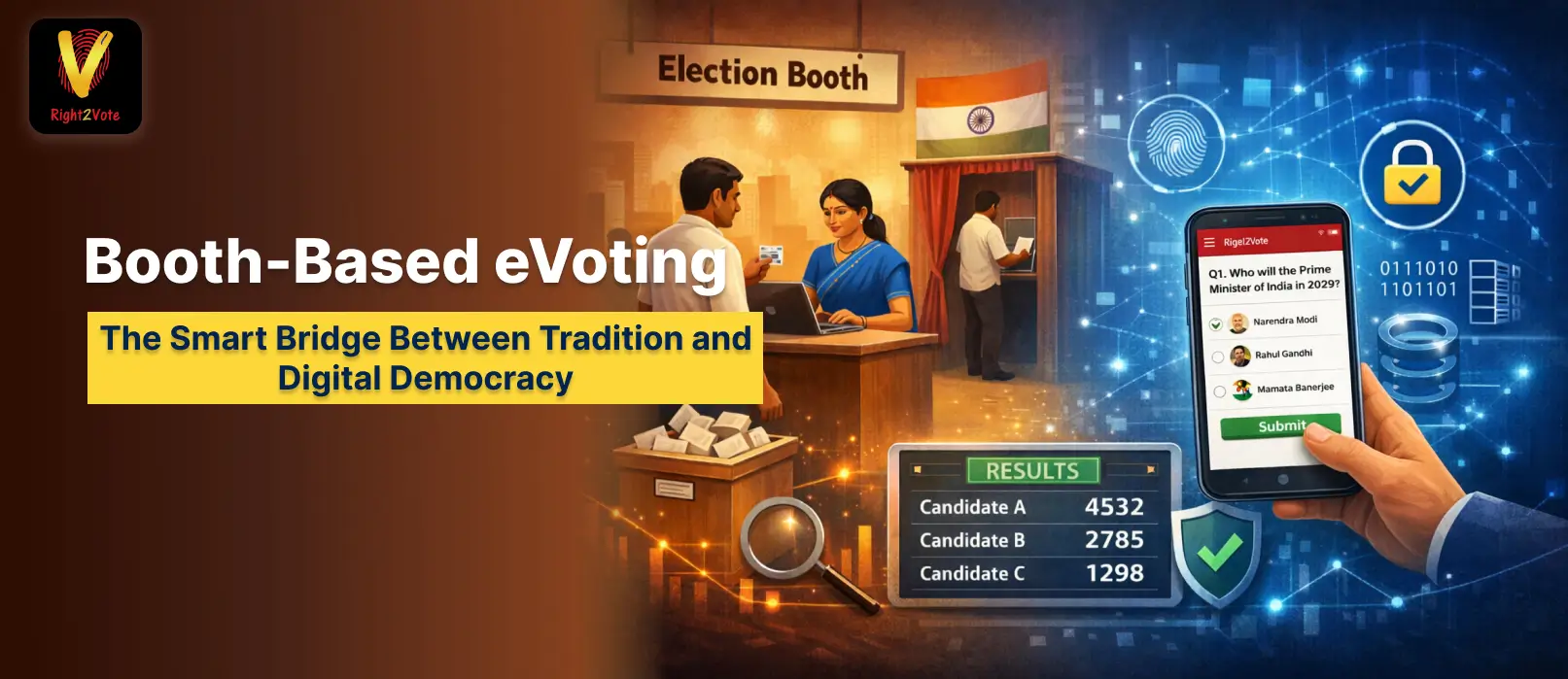
Booth-Based eVoting: The Smart Bridge Between Tradition and Digital Democracy
Overview
Booth-based eVoting represents the most practical evolution of traditional elections in the digital age. It combines the familiarity and trust of physical polling booths with the speed, accuracy and transparency of modern digital voting systems. Instead of replacing the booth, this approach strengthens it, allowing voters to verify themselves in person, vote privately and benefit from instant, error-free counting. In this page, we explain what booth-based eVoting is, how it differs from EVMs and online voting, how the process works in real elections and why platforms like Right2Vote make booth-based digital voting secure, scalable and trustworthy for modern organisations and institutions.
What Is eVoting?
Electronic Voting, commonly known as eVoting, refers to the process of casting and counting votes using digital technology instead of paper ballots. The goal of eVoting is simple yet powerful: to make elections faster, more accurate, transparent and accessible without compromising the sanctity of the vote.
Over the years, eVoting has evolved in different forms. From Electronic Voting Machines (EVMs) used in government elections to internet-based voting systems used by organisations worldwide, the core idea remains the same: reduce human error, eliminate manual counting and strengthen trust in the electoral process. However, how eVoting is implemented matters just as much as the technology itself.
eVoting Through EVMs vs Internet-Connected Devices
Traditional EVMs are standalone electronic machines deployed at polling stations. They are reliable, familiar and have played a significant role in large-scale elections. However, EVMs are hardware-intensive, difficult to upgrade and limited in flexibility. Every election requires large-scale logistics, transportation, storage and physical security arrangements.
On the other hand, internet-based voting allows voters to cast their vote using a mobile phone, laptop or computer from anywhere in the world. While this model offers unmatched convenience and accessibility, it also raises concerns for some stakeholders, especially around voter supervision, coercion and legal acceptance.
Booth-Based Digital Voting sits perfectly between these two approaches. It keeps the physical discipline of polling booths while introducing the efficiency, security and transparency of digital systems.
Booth-Based Digital Voting: A Practical Innovation
One of the most practical and widely acceptable innovations in modern elections is Booth-Based Digital Voting via Right2Vote. This model is designed especially for voters and organisations that trust traditional polling booths but want the speed, accuracy and transparency of digital technology. Instead of forcing a sudden shift to fully remote online voting, booth-based eVoting modernises the existing system without breaking voter confidence.
The Experience: Voters still visit an official polling station, interact with election officials, and vote in a private booth. Behind the scenes, advanced digital technology ensures strong authentication, zero duplicate voting, instant counting, and tamper-proof audit trails.
Voters still:
- Visit an official polling station
- Interact with election officials
- Vote in a private booth
But behind the scenes, advanced digital technology ensures:
- Strong authentication
- Zero duplicate voting
- Instant, accurate counting
- Tamper-proof audit trails
In short, the experience feels familiar to voters, while the efficiency feels revolutionary to organisers.
Why Many Organisations Still Prefer Physical Booth Voting
While online voting is significantly more flexible and scalable, many organisations still prefer booth-based voting for practical and legal reasons.
In some cases, organisational bylaws or governing laws explicitly require physical booth voting and do not permit remote online voting.
Some stakeholders fear that remote voting could lead to coercion, as voters may not be voting from the privacy of a booth.
Many organisations do not have updated voter databases with verified email IDs or mobile numbers, making OTP-based online authentication difficult.
Often, elections are conducted alongside events such as Annual General Meetings, Special General Meetings, alumni meets or conferences, where booth-based voting ensures both high turnout and participation in the event.
And in many cases, resistance to change plays a role. Booth-based voting is familiar, trusted and deeply ingrained. Even today, thousands of housing societies, cooperatives, trade unions, clubs, associations and corporate bodies prefer voting in a controlled environment. Right2Vote respects this preference while upgrading the process digitally.
How Right2Vote Sets Up a Smart and Simple Digital Voting Booth
Right2Vote simplifies booth-based voting through a thoughtfully designed digital setup. Each booth device whether a laptop or tablet is pre-logged in using a dedicated Booth ID such as booth1@right2vote.in. These devices are authorised in advance and cannot be used outside the polling environment.
A voter arrives at the registration desk, gets verified and receives a unique one-time voting code. The voter then enters the booth, types the code on the authorised device and casts their vote in seconds. Multiple voters can vote one after another on the same device, making the system extremely efficient even during peak hours. Right2Vote also allows booth voting and postal or remote voting to run simultaneously, enabling hybrid elections without confusion or overlap.
For organisations that require an additional layer of verification, an optional Voter Selfie feature can be enabled.
The Unique Voting Code: The Heart of Booth-Based Security
At the core of Right2Vote’s booth-based system lies the unique one-time voting code. Each voter receives a code that works only once. Once used, it becomes invalid automatically. This guarantees one voter, one vote without exception.
Codes can be pre-generated in bulk or created live at the booth for enhanced security. Election organisers can track code usage in real time through the admin dashboard, including when and where each code was used.
Mapping: For internal tracking, organisers may optionally map codes to voter names or membership numbers without compromising vote secrecy.
Optional Voter Information & How Secret and Non-Secret Ballots Are Handled
Collecting Voter Information: Some organisations require voter attendance records. Right2Vote allows the optional collection of basic voter details such as name, membership number, phone number or email ID.This information is stored securely in the admin dashboard and is never linked to the voter’s choice in a secret ballot election. Transparency and secrecy coexist without conflict.
Secret and Non-Secret Ballots: Right2Vote supports both secret and non-secret ballots, depending on the nature of the election. In secret ballots, results display only anonymised data such as voting code, time and IP address. Even the admin cannot see who voted for whom. In non-secret ballots, often used for resolutions or corporate decisions, results may display voter details and vote choices to ensure full transparency.
Fast and Smooth Voter Experience and Strong Security for Booth Voting
Voter Experience: From entry to exit, a voter can complete the entire process in under 30 seconds. Even if a voter pauses mid-way, the code remains valid until used. Short queues, minimal confusion and a stress-free experience make booth-based digital voting especially friendly for senior citizens and first-time voters.
Tamper-Proof Security: Right2Vote combines physical supervision with advanced digital security. Private Poll settings restrict access to authorised devices. IP restrictions block external attempts. One-time codes prevent duplicate voting. Optional selfies add another layer of assurance. Together, these safeguards create a fully controlled, tamper-proof voting environment.
Booth-Based eVoting Works in Indian (National / State / Local Body) Elections
As demonstrated in Right2Vote’s flow, the process is designed to be simple and intuitive even for non-tech-savvy voters.
- A voter arrives at any authorised polling booth set up by the Election Commission or the organising authority during the voting window. Instead of being restricted to a single hometown booth, the voter can visit the nearest authorised booth.
- At the verification desk, the voter presents their Voter ID or Aadhaar card to the polling officer. Once verified, the voter enters the digital voting booth.
- Inside the booth, the voter taps the “Vote” button on the screen, scans their Aadhaar QR code, verifies their details and completes authentication. The digital ballot appears on the screen, allowing the voter to select their preferred candidate or option. After submitting the vote, the voter confirms their selection and sees a simple “Thank You” message.
- The entire process takes just over a minute; queues move faster and manual errors disappear. Refer to the video
Why Booth-Based Digital Voting Builds Trust
In a country as large, diverse and complex as India, trust is the foundation of any electoral reform. Many voters remain sceptical of fully remote online voting and those concerns are valid.
Booth-based digital voting directly addresses these concerns by keeping voting within official polling stations under the supervision of trained election officers. Only genuine voters are physically present. Proxy voting becomes impossible. Booth capturing is eliminated through controlled access and digital safeguards.
Most importantly, voters cast their vote from the privacy of a booth, free from external pressure or coercion.
At the same time, booth-based eVoting removes one of the biggest barriers to participation, location. Migrant workers, students, professionals and urban voters no longer need to travel back to their hometowns. They simply visit the nearest authorised booth and exercise their Right to Vote, securely and conveniently.
This model blends the discipline of traditional elections with the efficiency of digital systems, creating trust on both sides of the change.
EVM vs Right2Vote’s Booth-Based Voting System
Digital transformation has changed how elections are conducted, but many organisations still prefer the comfort and control of physical voting booths. They want voters to come to a designated place, verify themselves at a counter and vote inside a booth just like traditional elections.
At the same time, they want to eliminate paper ballots, manual counting, invalid votes and long waiting times.
This is exactly where Right2Vote’s Booth-Based Digital Voting System stands apart from both paper ballots and traditional EVMs.
Unlike EVMs, Right2Vote does not rely on specialised hardware that is difficult to scale or upgrade. Instead, it works seamlessly on laptops, tablets, kiosks or secure devices while maintaining strict booth control.
Unlike paper-based systems, counting is instant, results are accurate, and audit logs are available in real time. Right2Vote transforms booth voting into a smarter, faster and more transparent experience without disrupting existing workflows.
Conclusion
Right2Vote removes every pain point of traditional voting. No paper, no ballot boxes, no manual counting, no delays. Results are instant. Accuracy is guaranteed. Hybrid elections are effortless. Participation increases, costs reduce and trust strengthens. Booth-based digital voting with Right2Vote is not a compromise—it is the smartest evolution of the voting booth. It empowers our community to elect leaders and make collective decisions with ease, security and confidence, no matter where in the world we are. Ultimately, eVoting is not just about convenience; it's about connection and building a more inclusive, participative future for all.