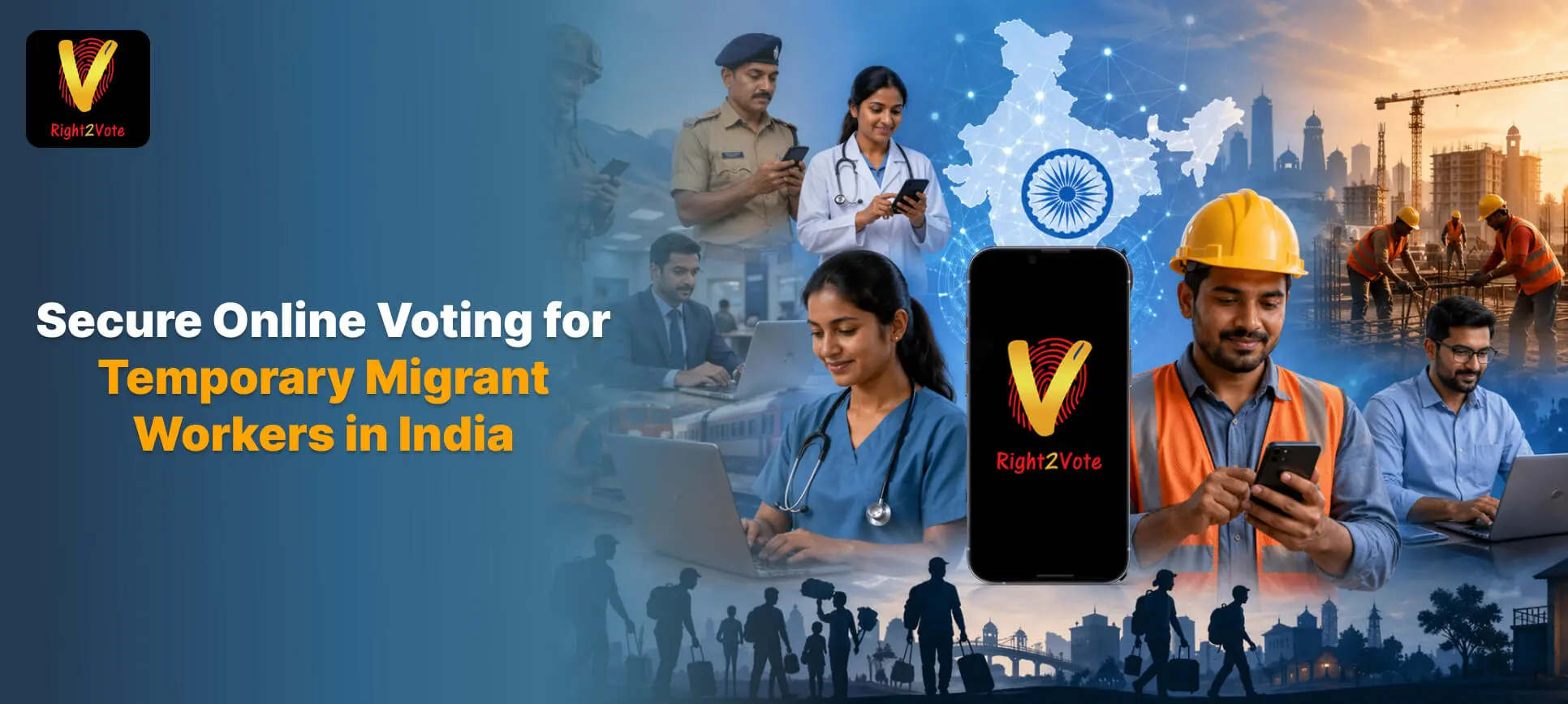
Secure Online Voting for Temporary Migrant Workers in India
Temporary migrant workers are one of the largest and most important contributors to India's economy. From building infrastructure to running essential services, their role is visible in almost every sector. These workers move from their hometowns to different cities or states in search of better opportunities or to fulfill professional responsibilities. This includes not only laborers but also professionals like doctors, engineers, bank officials and government staff who are frequently transferred.
This group is incredibly diverse. It includes:
- Government workers like army personnel, police forces, doctors and bank officials
- Public service workers in electricity, transport and administration
- Private sector professionals like IT employees and corporate staff
- Industrial workers in manufacturing units
- Daily wage earners and construction workers
- Skilled and unskilled laborers working far from their hometowns
Some of these individuals are serving the nation directly, while others are working tirelessly to support their families. They contribute to the economy, infrastructure and overall development of the country. Despite their contribution, a major issue remains unnoticed — their participation in voting is extremely low. During major elections like the Indian General Elections and State elections, millions of migrant workers are unable to vote simply because they are not present in their registered constituency.
Who Are Temporary Migrant Workers?
Temporary migrant workers are individuals who relocate from their home region to another place for employment, either for a short period or long-term assignments. This group is not limited to a single category but spans across multiple sectors and professions.
- Government and Public Sector Workers
- Army and paramilitary personnel posted across different regions
- Government doctors working in rural or urban assignments
- Bank officials transferred frequently
- Administrative officers and public servants
- Essential Service Providers
- Electricity board workers
- Transport and railway staff
- Municipal and civic workers
- Private Sector Professionals
- IT professionals working in metro cities
- Corporate employees with transferable jobs
- Sales and field staff traveling across regions
- Industrial and Labor Workforce
- Factory and manufacturing workers
- Construction laborers working on infrastructure projects
- Migrant workers in textiles, mining and other industries
What unites all these groups is mobility. While their work supports economic growth and development, it also creates a disconnect from their registered voting locations. This mobility, which is essential for their livelihood and national service, becomes the biggest obstacle when it comes to exercising their right to vote.
The Reality: Why Migrant Workers Miss Voting
The inability of migrant workers to vote is not a matter of choice but a result of multiple practical challenges. One of the biggest issues is distance. Most workers are registered in their hometowns, but their jobs take them far away, sometimes across states. Traveling back just to vote requires time and resources that many cannot afford.
- Physical Distance from Registered Constituency: Most migrant workers are registered to vote in their hometowns. However, their work takes them hundreds or even thousands of kilometers away. Traveling back just to vote is not practical.
- Loss of Daily Income: For many workers, especially daily wage earners, taking time off means losing income. Traveling home for voting can result in multiple days of lost wages.
- High Travel Costs: Transportation expenses can be significant, particularly for long distances. Many workers cannot afford the cost of travel just for voting.
- Fixed Voting Dates: Elections are conducted on specific dates, leaving little flexibility. Workers cannot always take leave from their jobs during these periods.
- Lack of Employer Support: In many sectors, especially informal ones, workers do not receive paid leave for voting. This discourages them from participating.
- Complex Voter Registration Issues: Updating voter registration to a new location is often complicated and time-consuming. As a result, many workers remain registered in their hometowns.
Example: A construction worker from Bihar working in Mumbai may need to travel for over 24 hours to reach his village. Doing so means losing wages, spending money on travel and risking job security. In most cases, he chooses not to vote.
The Impact of Low Participation
When a significant portion of the population does not participate in voting, it directly affects the strength and fairness of democracy. Temporary migrant workers represent millions of citizens and their absence from the voting process creates a serious representation gap.
- Policies may not reflect the needs of migrant workers
- Their challenges remain unaddressed
- Political representation becomes incomplete
- Democracy loses inclusivity
These workers are the ones building roads, running industries, managing systems and serving the nation. Yet, their voices often remain unheard during elections. Moreover, it affects engagement. When workers feel that their participation does not matter or is too difficult, they become less involved in civic activities. Over time, this creates a disconnect between citizens and governance.
Ensuring higher participation from migrant workers is not just about fairness — it is about strengthening democracy and making it truly inclusive for every citizen.
The Need for a Modern Voting Solution
India has made significant progress in digital transformation across various sectors such as banking, education and healthcare. People can transfer money, attend classes and consult doctors online. However, voting still largely depends on physical presence, which does not suit the realities of a mobile workforce.
For a country with such a massive migrant population, this model needs to evolve. A modern voting system should:
- Allow voting from any location
- Be secure and tamper-proof
- Be simple and accessible for all types of users
- Ensure transparency and trust
Such a system would not only benefit migrant workers but also improve overall voter turnout. It would make the process more inclusive and efficient, aligning with the needs of a rapidly changing society. This is where secure online voting emerges as a powerful and practical solution, capable of bridging the gap between citizens and their right to vote.
How Online Voting Can Empower Migrant Workers
Online voting has the potential to transform the way migrant workers participate in elections. By removing the requirement of physical presence, it directly addresses the biggest challenge they face.
- Vote from Anywhere: Workers can cast their vote from their workplace, accommodation, or any location using a mobile phone or computer.
- No Travel Required: Eliminates the need to travel long distances, saving time, money and effort.
- Flexible Voting Window: Online voting can be open for extended hours or days, allowing workers to vote at their convenience.
- No Loss of Income: Workers do not have to take leave or lose wages to participate in elections.
- Easy and Quick Process: Voting can be completed in a few simple steps, making it accessible even for first-time users.
- Increased Participation: When voting becomes convenient, more people participate, leading to better representation.
Example: An IT professional from Kerala working in Bengaluru can vote online during a lunch break instead of traveling back home.
Right2Vote: Ensuring No One Is Denied Their Right to Vote
Right2Vote is committed to solving this problem with its secure and reliable eVoting platform. Right2Vote is on a simple but powerful mission — no one should be denied their right to vote. The platform is designed to address the challenges faced by migrant workers and provide them with a secure and accessible way to participate in elections.
How Right2Vote Supports Migrant Workers
- Secure Voting System:
- OTP-based authentication
- Encrypted voting process
- Protection against fraud and manipulation
- User-Friendly Interface: The platform is designed for simplicity, ensuring that even workers with limited technical knowledge can use it.
- Mobile Accessibility: Since most users have access to smartphones, the platform works seamlessly on mobile devices.
- Scalable for Large Populations: Right2Vote can handle elections involving thousands of voters.
- Transparent and Verifiable: Election administrators can monitor the process in real time, ensuring fairness.
- Instant Results: Automated counting ensures quick and accurate results without manual errors.
By combining security, simplicity and accessibility, Right2Vote ensures that migrant workers can exercise their voting rights without facing the barriers of traditional systems.
Hybrid Voting: Bridging the Gap
While online voting offers many advantages, it is important to recognize that not everyone may be ready to adopt it fully. This is where the hybrid voting model becomes highly effective. It combines the strengths of both online and traditional voting methods to create a more inclusive system.
- Online voting for remote participants
- Booth-based voting for those who prefer traditional methods
In a hybrid model, voters have the option to choose how they want to vote. Those who are comfortable with technology can use online voting, while others can still visit physical polling booths. This flexibility ensures that no one is excluded based on their preferences or access to technology.
This approach also helps organizations and institutions transition smoothly from traditional to digital systems. It builds confidence among users and gradually increases acceptance of online voting. By offering flexibility and inclusivity, hybrid voting acts as a bridge between the old and new systems, ensuring maximum participation.
Why This Matters for India's Democracy
India is known as the world's largest democracy and its strength lies in the participation of its people. However, when millions of migrant workers are unable to vote, it creates a gap that affects the overall system. Inclusive voting is essential for fair representation. When every section of society participates, policies and decisions become more balanced and effective. Migrant workers, who contribute significantly to the economy and infrastructure, deserve to have their voices heard.
Enabling them to vote strengthens trust in the democratic process. It shows that the system is adaptable and responsive to the needs of its citizens. Higher participation also leads to better governance, as leaders are chosen by a more representative population. In the long run, improving voter access for migrant workers can lead to positive changes in policy-making, social welfare and economic development. It ensures that democracy works for everyone, not just those who are easily able to access polling booths.
Real Impact: Giving Voice to the Workforce
Imagine the impact if millions of migrant workers could vote without barriers:
- A factory worker in Gujarat voting for leaders in his hometown
- A nurse working in Delhi participating in her state elections
- A soldier posted at the border having a secure way to cast their vote
- A construction worker voting without losing a day's wage
This is not just convenience — it is empowerment.
The Future of Voting in India
While public elections under the Election Commission of India are still exploring remote voting solutions, platforms like Right2Vote are already demonstrating how technology can solve real-world problems. In the future, we can expect:
- Greater adoption of remote voting systems
- Increased participation from migrant workers
- More inclusive and representative elections
- Stronger democratic processes
Solutions like online and hybrid voting offer a way forward. They remove barriers, increase participation and make the system more inclusive. Platforms like Right2Vote are already working toward this vision, ensuring that no one is left behind.
Final Thoughts: Every Worker, Every Vote
Temporary migrant workers are the driving force behind India's growth. They build cities, run industries and provide essential services that keep the country moving forward. Despite their contributions, many of them miss out on voting due to practical challenges. This is not just an inconvenience — it is a gap that needs to be addressed. Voting is a fundamental right and every citizen should have the opportunity to exercise it, regardless of their location or profession.
Right2Vote is working toward a future where:
- No worker has to choose between earning a livelihood and voting
- No citizen is excluded because of location
- Every voice is heard, regardless of where they are
In a true democracy, every voice matters. By empowering migrant workers to vote, we move closer to a system that is fair, inclusive and representative of all. Because at the end of the day, every worker deserves not just to build the nation, but also to have a say in its future.