Online Election Using a Secure Digital Voting System
Elections are the backbone of any democracy. They decide who governs us, how policies are shaped, and how power is transferred peacefully. For decades, India and many other democracies have relied on traditional voting methods: paper ballots, then Electronic Voting Machines (EVMs). While these systems have served their purpose, the world around us has changed rapidly. Banking is digital, education is digital, governance is digital, so the natural question arises: why should elections remain stuck in the past?
This is where Online Elections using a secure Digital Voting System come into the picture. Platforms like Right2Vote are not just experimenting with technology; they are redefining how trust, transparency, and participation can be strengthened in modern elections.
Why the Need for Online Elections Today?
Low voter turnout is a growing concern across the world, including in large democracies like India. Despite having the right to vote, millions of citizens stay away from elections every year. The reasons are often practical rather than political, such as long queues at polling booths, the need to travel back to hometowns, work and business commitments, health issues, extreme weather conditions, or even safety concerns. In urban areas, professionals find it difficult to take time off, while migrant voters are often unable to travel on election day. In some cases, lack of trust in the system or fear of manipulation also discourages participation. As society becomes more digital and mobile, citizens expect voting to be as convenient as other essential services.
Online elections solve many of these problems by:
- Making voting faster and more accessible
- Reducing dependency on physical infrastructure
- Increasing participation among youth, migrants, and urban professionals
- Bringing transparency and auditability through technology
A Digital Voting System does not replace democracy, it strengthens it by making participation easier, safer and more reliable for every eligible voter.
Understanding Digital Voting Systems in Simple Terms
As technology becomes part of everyday life, elections are also evolving. Digital voting systems use secure technology to conduct elections in a faster, more transparent and more accessible way while maintaining voter trust, privacy and democratic values.
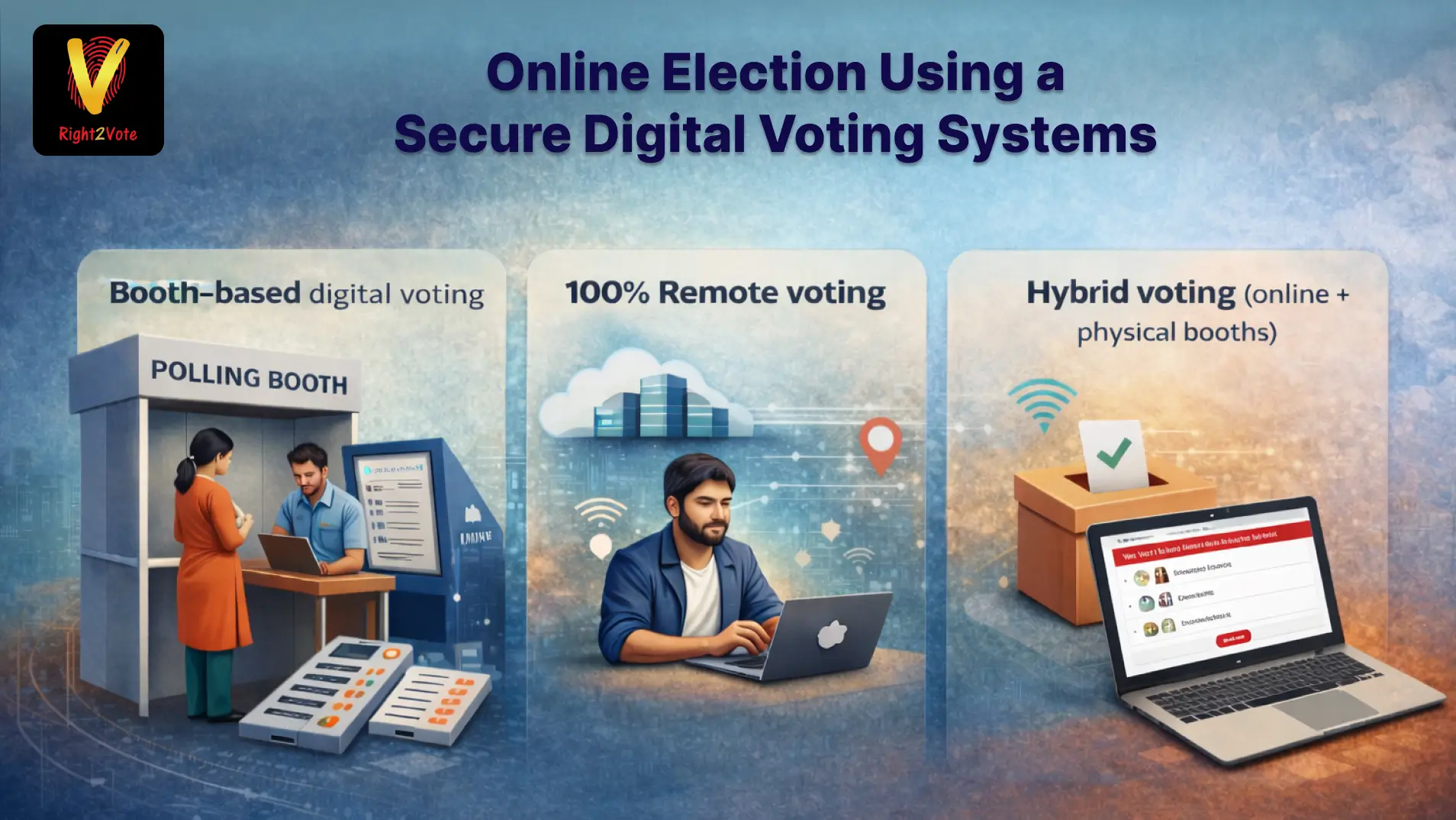
A digital voting system is a technology-driven election process where voting is conducted using secure software instead of paper ballots. It can work in different ways:
Right2Vote has developed solutions that adapt to Indian conditions and voter behaviour, somethings imported systems often fail to do.
Booth-Based Digital Voting
One of the most practical innovations in modern elections is Booth-Based Digital Voting via Right2Vote. It is designed especially for voters who trust traditional polling booths but want the speed, accuracy, and transparency of digital systems. Instead of forcing a sudden shift to remote online voting, this model modernises the existing booth-based process. Voters still visit an official polling station, interact with election officials, and vote in a controlled environment while advanced digital technology works silently in the background to ensure security, accuracy and trust.
How Booth-Based eVoting Works in Indian Elections
As shown in the Right2Vote demonstration video, the process is simple and voter-friendly:
- Visit any polling booth set up by the Election Commission during the voting window.
- Show your Voter ID or Aadhaar card to the polling officer.
- Enter the digital voting booth.
- Tap the “Vote” button on the screen.
- Scan your Aadhaar QR code.
- Verify your details and complete authentication.
- View the digital ballot, select your candidate, and submit your vote.
- Confirm your selection and see a “Thank You” message.
This entire process takes just over a minute, reducing queues and human error while maintaining strict verification.
Why Booth-Based Digital Voting Builds Trust
Many voters are sceptical of fully remote voting, and these concerns are valid in a country as large and diverse as India. Booth-based digital voting directly addresses these issues by keeping the voting process within official polling stations under the supervision of trained election officers. This ensures that only genuine voters are present and prevents practices like booth capturing or proxy voting. At the same time, voters no longer need to travel back to their hometowns to cast their vote. They can simply visit the nearest authorised polling booth and exercise their Right to Vote securely and conveniently.
- Ensures voting within official polling stations
- Ensuring voter presence and supervision
- Eliminating booth capturing
- Most important, eliminates chances of coercion as voter voters from privacy of a booth
It combines the discipline of traditional elections with the efficiency of digital systems.
Cloud-Based Elections: Powering Scale and Speed
Modern elections generate massive amounts of sensitive data, including voter details, authentication logs, vote records, and result summaries. Managing this information securely, accurately, and at scale is a major challenge for election authorities and organisations. Traditional systems often rely on physical servers, manual processes, and delayed reporting, which increases cost and risk. Right2Vote’s cloud-based election infrastructure addresses these challenges by using secure, audited cloud technology that ensures data protection, high availability, and real-time access. This approach allows elections to be conducted smoothly, even with large electorates, while maintaining transparency, accuracy, and trust throughout the entire election process.
Benefits of Cloud-Based Digital Elections
- Real-time vote recording
- Instant counting and result generation
- Secure data storage with encryption
- Scalability for large electorates
- Reduced operational costs
Cloud-based elections are especially effective for trade unions, housing societies, universities, professional bodies, and corporate or shareholder voting. They also support eco-friendly elections by significantly reducing paper usage and physical resource consumption.
They also make elections eco-friendly by reducing paper usage.
EVM vs Online Voting: A Necessary Evolution
Electronic Voting Machines (EVMs) were a significant step forward from paper ballots, helping reduce invalid votes and speeding up counting. However, they still depend heavily on physical processes, which create operational challenges. EVM-based elections require large-scale transportation, storage and security arrangements, increasing both cost and risk. Public audit transparency is also limited, as voters cannot independently verify the overall process.
Limitations of EVMs include:
- Physical dependency, as machines must be transported and guarded.
- Logistics-heavy deployment, requiring extensive manpower and planning.
- Storage and transport risks, including damage or tampering concerns.
- Limited audit transparency makes verification difficult for the public.
When designed securely, online voting systems overcome many of these issues by using technology-driven safeguards.
Advantages of Online Voting Systems include:
- End-to-end encryption to protect votes from manipulation.
- Voter verification logs to ensure only eligible voters participate.
- Time-stamped vote records for accuracy and traceability.
- Independent audit trails that enhance transparency and public trust.
This does not mean EVMs are obsolete, but the future clearly lies in secure digital voting systems that evolve with technology.
Online Voting: 100% Remote Voting
Online voting allows eligible voters to cast their ballots using the internet from any location, removing the need to visit a physical polling booth. This level of convenience is especially valuable for senior citizens, persons with disabilities, migrant workers, students living away from home and professionals with tight schedules. However, because voting happens remotely, online voting also raises important concerns that must be addressed carefully to maintain trust in the electoral process.
The main challenges of online voting include identity verification, ensuring that the person voting is the genuine voter; device security, as personal devices may be shared or compromised; and network manipulation, where data transmission must be protected from interception or tampering. Ignoring these risks can weaken confidence in online elections.
Right2Vote addresses these concerns through a strong security-first approach. It uses multi-factor authentication so that voting cannot be completed using a single credential. Aadhaar-based verification helps confirm voter identity, while voter selfieand AI face detection ensure that the voter is physically present during voting. Geo Tagging and IP Restriction prevent multiple votes from the same account or device misuse.
Compared to booth-based voting, online voting offers greater flexibility. Voters do not need to travel to any booth, wait in queues or depend on fixed voting hours. This leads to higher participation, especially among urban and mobile populations. When designed securely, online voting expands access to democracy while maintaining transparency and trust.
Hybrid Voting: The Best of Both Worlds
Not every voter is comfortable with fully online voting, especially in a country as diverse as India. While younger and urban voters are quick to adopt digital tools, many elderly citizens and rural voters still prefer the familiarity and trust of physical polling booths. Hybrid voting bridges this gap by offering both options within the same election framework, allowing voters to choose the method they are most comfortable with instead of forcing a one-size-fits-all approach.
Hybrid voting allows:
- Tech-savvy voters to cast their vote online using secure digital platforms
- Traditional voters to vote at physical polling booths with official supervision
This flexible model makes elections more inclusive and practical for real-world conditions.
India also has the world’s largest youth population, estimated between 371 and 420 million young people, many of whom are digitally active and prefer online services. Young voters expect speed, convenience and mobile access, and online voting aligns naturally with their lifestyle. At the same time, hybrid voting ensures that those who are not digitally confident are not excluded from the democratic process.
This inclusive approach helps by:
- Increasing voter turnout across age groups and regions
- Reducing resistance to change, as voters transition gradually to digital methods
- Ensuring no voter is left behind, regardless of age, location or digital literacy
Because of this balance, hybrid voting is proving especially effective in large, diverse electorates like India, where inclusion and choice are essential for strong democratic participation.
Accurate Voter Lists: The Foundation of Fair Elections
Even the most advanced voting system cannot deliver fair results if the voter list itself is inaccurate. Errors such as duplicate entries, outdated records or fake voters directly weaken the credibility of elections. This is why SIR (Special Intensive Revision) is linked with Aadhaar. By verifying voter records against Aadhaar data in a secure and lawful manner, election authorities can clean and update voter databases before an election. A verified voter list ensures that only eligible voters can participate, prevents misuse of identities and strengthens public trust in digital elections. Ultimately, a clean and accurate voter database forms the foundation of transparency, fairness, and confidence in any online or digital voting system.
SIR linked with Aadhaar helps to:
- Remove duplicate entries from voter lists
- Eliminate fake or inactive voters
- Ensure one person, one vote
A clean voter database is the backbone of transparent and trustworthy digital elections.
India’s Progress Toward Digital Elections, Technology and Trust
India is steadily moving toward digitally enabled elections, driven by the need for transparency, efficiency, and higher voter participation. Successful eVoting implementations in states like Gujarat and Bihar have demonstrated that digital elections are not just concepts or pilot ideas; they work in real conditions. These initiatives show that voters adapt quickly to technology, election authorities benefit from smoother operations, and results become faster and more reliable. At the same time, modern election technology now goes far beyond just casting a vote. Platforms like Right2Vote offer a complete digital election ecosystem backed by strong security standards, helping build public confidence and curiosity around online elections.
These pilot implementations prove that:
- Voters adapt quickly to digital voting systems
- Voter turnout improves, especially among youth and urban voters
- Administrative efficiency increases with faster counting and reporting
Security: The Heart of Digital Voting Systems
Security is the biggest concern in online elections, and Right2Vote treats it as absolutely non-negotiable. Every layer of the platform is designed to protect voter identity, vote secrecy and election integrity. With ISO 27001 certification, regular STQC certification and CERT-In empanelment testing, Right2Vote follows nationally approved security standards. End-to-end encryption ensures that votes remain protected from the moment they are cast until counting is complete, while tamper-proof audit logs record every action within the system. This allows complete traceability and verification without revealing how an individual voted, maintaining voter privacy and public trust.
- ISO 27001 certification
- STQC certification
- MCA approval
- Audit by CERT-In empanelment Testing agency
- End-to-end encryption
- Tamper-proof logs
Every action is recorded, traceable and auditable, without compromising voter privacy.
Why Online Elections Spark Curiosity?
Online elections change how people experience democracy. When voters see that the entire voting process can be completed in minutes, verified instantly, counted transparently and audited independently, their perception of elections shifts. Instead of viewing voting as time-consuming or complicated, it becomes simple and reliable. Transparency builds confidence, speed improves participation, and independent auditability reassures that the results are genuine. This combination does not just make online elections acceptable; it makes them trustworthy, encouraging more citizens to participate actively and confidently in the democratic process.
- Completed in minutes
- Verified instantly
- Counted transparently
- Audited independently
They don’t just accept digital elections; they trust them.
Online elections are not about replacing democracy with machines. They are about empowering citizens, restoring faith in institutions and making participation effortless.
Conclusion: The Future Is Digital, Secure and Inclusive
Online Elections using a secure Digital Voting System are no longer a future vision; they are today’s reality. With over 10 years of experience, 21,000+ successfully conducted elections, and a proven track record across India, Right2Vote has established itself as a trusted name in digital democracy. From housing societies, RWAs, associations, clubs, and trade unions to medical bodies, institutions, schools, and universities, Right2Vote conducts elections anywhere, anytime, with the same level of security and transparency.
To know more about Right2Vote’s election technology, please refer:
- Government of India certificates
- Features for eVoting
- Security and safety
- Pricing
- Our customers
- Contact Us
Types of elections :
Important links :
Recent Blogs :
-
 How to Conduct an AGM Online: A Complete Guide to Online Meetings and Voting
-
 Digital Nomination: Making Election Nominations Simple, Accessible and Efficient
-
 How ISBAA Conducted a Secure and Transparent Online Senate Election with Right2Vote
-
 Finding It Difficult to Conduct Elections? Make Elections Simple with Right2Vote